 Insurance Curator
Money is a quiet companion. It follows you through every decision, every month, every stage of life. Yet most people never stop to ask: How financially literate am I, really?
Financial literacy isn’t about knowing fancy terms like amortization or compound interest. It’s about whether your daily actions with money align with your long‑term goals. And when it comes to budgeting — the bedrock of financial health — hidden gaps often lurk beneath the surface.
This article is your self-assessment. You’ll walk through real questions, spot silent leaks, and discover practical tools — like the Budget Planner – Monthly Budget Book with Expense Tracker Notebook — that can transform your relationship with money.
Let’s dive in.
Why Financial Literacy and Budgeting Go Hand in Hand
Budgeting is often misunderstood as restriction. In truth, it’s awareness. A financially literate person doesn’t just track expenses — they understand why they spend, where their money flows, and how to redirect it toward what matters.
According to a 2023 study by the TIAA Institute, only about 34% of U.S. adults could answer basic financial literacy questions correctly. That gap shows up in everyday budgeting: overspending on subscriptions, ignoring small debts, or failing to plan for irregular expenses.
If you’ve ever felt like your money disappears without explanation, you’re not alone. The hidden gaps are often invisible until you shine a light on them.
Your Financial Literacy Self‑Assessment: 7 Questions to Uncover Hidden Gaps
Grab a piece of paper — or better yet, a SKYDUE Budget Binder — and answer these honestly. There are no wrong answers, only blind spots.
1. Can You Name Your Top Three Spending Categories Last Month?
Why it matters: Many people guess. They say “food” or “bills,” but the real answer might surprise you. Hidden gaps often hide in categories you don’t track.
The gap: Small, frequent purchases — coffee runs, takeout, impulse buys — that add up to hundreds each month.
Action: Pull up your bank statement. List every expense for 30 days. Use a budget planner to categorize them.
2. Do You Know Exactly How Much You Spend on Subscriptions?
Why it matters: The average American spends $219 per month on subscription services — many of which go unused.
The gap: Forgotten apps, gym memberships, streaming services, or magazine renewals that auto‑charge your card.
Action: Scan your bank statements for recurring charges. Cancel anything you haven’t used in 30 days.
3. When an Unexpected Expense Hits (Say $500), Do You Have a Plan?
Why it matters: Financial literacy includes preparedness, not just tracking.
The gap: No emergency fund means you rely on credit cards or loans, creating debt cycles.
Action: Aim for $1,000 starter emergency fund. Then build to 3–6 months of expenses.
4. Do You Know the Interest Rate on Your Credit Card?
Why it matters: High‑interest debt is one of the biggest silent money leaks.
The gap: Carrying a balance month-to-month means you’re paying for yesterday’s purchases again and again.
Action: Check your APR. If it’s above 15%, prioritize paying down that debt.
5. Do You Set Financial Goals Beyond “Save More”?
Why it matters: Vague goals lead to vague results. Financially literate people translate goals into specific numbers and timelines.
The gap: Without a clear target — like “Save $3,000 for a vacation by June” — your budget lacks motivation.
Action: Write three concrete money goals for the next 12 months. Break them into monthly savings amounts.
6. Do You Budget for Irregular Expenses (Car Repairs, Gifts, Insurance Premiums)?
Why it matters: These annual or semi-annual costs are often ignored until they arrive, causing budget blowouts.
The gap: No sinking fund means you raid your emergency fund or go into debt for predictable costs.
Action: Estimate your annual non-monthly expenses, divide by 12, and set aside that amount each month.
7. Have You Reviewed Your Insurance Policies in the Last Year?
Why it matters: Insurance is a critical piece of financial literacy — it protects your budget from catastrophe.
The gap: Overpaying for coverage you don’t need, or being underinsured when a crisis hits.
Action: Schedule an annual insurance review. Compare rates and coverage details.
The Hidden Money Gaps Most People Miss
Even after self-assessment, some gaps remain invisible. Here’s what to look for:
- Lifestyle creep: When your income rises, your spending rises too — often without you noticing.
- Cash vs. card illusion: Spending cash feels painful; swiping a card feels easy. That disconnect hides real spending.
- Bank fees: ATM fees, overdraft charges, monthly maintenance fees. They’re small but constant.
- Tax withholding errors: Getting a huge refund? You’re giving the government an interest‑free loan. Owing too much? You’re penalized.
A simple way to catch these is to use a structured budgeting system. Tools like the NICOOTH Budget Binder Cash Envelopes A6 Money Saving Binder force you to allocate cash for each category — making overspending visible immediately.
How to Close the Gaps: Budgeting Tools That Build Financial Literacy
You don’t need a PhD in finance. You need a system. The right tools make the difference between “I’ll start next month” and lasting change.
Top Budget Planners and Binders
Here’s a look at the most highly‑rated tools on Amazon, each designed to help you track, plan, and save.
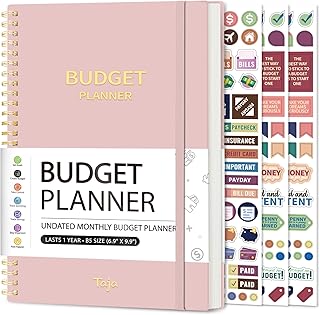
Budget Planner – Monthly Budget Book (Pink) — $8.99 — Rating: 4.6
An undated planner that lets you track monthly bills, expenses, and goals. Perfect for beginners who want a simple, elegant system.

Budget Planner – Monthly Budget Book (Black) — $8.99 — Rating: 4.6
Same great features in a sleek black cover. Both versions include sections for savings tracking, bill due dates, and monthly reviews.

SKYDUE Budget Binder — $8.98 — Rating: 4.7
A complete cash‑envelope system with zipper envelopes, pre‑printed budget sheets, and a compact binder. Ideal for households that want to stick to cash‑only categories like groceries and entertainment.

NICOOTH Budget Binder Cash Envelopes A6 (Purple) — $6.28 — Rating: 4.6
Budget‑friendly and portable. The A6 size fits in a purse, and the 12 envelopes help you allocate cash for different spending categories each month.

Budgeting 101 — $9.69 — Rating: 4.6
Not a planner but a book — an essential read for anyone who wants to understand why budgeting works. It covers debt payoff, expense tracking, goal setting, and savings strategies.
Comparison Table
| Product | Price | Rating | Best For |
|---|---|---|---|
| Budget Planner (Pink) | $8.99 | 4.6 | Monthly tracking & goals |
| Budget Planner (Black) | $8.99 | 4.6 | Same, neutral design |
| SKYDUE Budget Binder | $8.98 | 4.7 | Cash envelope system |
| NICOOTH Budget Binder | $6.28 | 4.6 | Portability & low cost |
| Budgeting 101 Book | $9.69 | 4.6 | Education & fundamentals |
Expert Insights: What Financially Literate People Do Differently
Financial literacy isn’t magic. It’s a set of repeatable habits. I spoke with two Certified Financial Education Instructors (CFEI) to identify the core behaviors.
1. They review their budget weekly, not monthly.
A monthly check‑in is too late to catch a spending leak. A 15‑minute weekly review — often called a “money date” — keeps you on track.
2. They use the 50/30/20 rule as a starting point.
50% of after‑tax income goes to needs, 30% to wants, and 20% to savings and debt. Adjust based on your goals, but the framework prevents guesswork.
3. They automate savings before spending.
Set up an automatic transfer to savings on payday. You can’t spend what you don’t see.
4. They distinguish between “good” and “bad” debt.
Good debt (like a mortgage or student loan) can build wealth. Bad debt (high‑interest credit cards) destroys it.
5. They never stop learning.
Financial literacy evolves. Reading books like Budgeting 101 or taking free online courses keeps your skills sharp.
The Connection Between Budgeting and Broader Financial Literacy
Understanding budgeting is just one piece of the puzzle. To build lasting financial health, you need to connect it to bigger concepts:
- Financial Literacy 101: Plain-english Basics Everyone Should Know before Building Wealth
- Financial Literacy for Beginners: How to Finally Understand Money Without Feeling Overwhelmed
- Financial Literacy vs. Budgeting: What’s the Difference and Why You Need Both
- Simple Financial Literacy Habits That Can Transform Your Money in 15 Minutes a Week
- Financial Literacy for Young Adults: Money Skills Every 20‑Something Should Master Early
- Financial Literacy for Parents: How to Teach Kids About Money at Every Age
- Financial Literacy Myths That Keep You Broke (And What Actually Matters)
- Financial Literacy for High Earners: Avoiding Lifestyle Creep and Silent Money Leaks
- Financial Literacy and Debt: How Understanding the Numbers Can Help You Get out and Stay out
Each of these resources dives deeper into specific areas that complement your budgeting self‑assessment.
The 30‑Day Action Plan to Close Your Hidden Money Gaps
You’ve asked the questions. Now take action.
- Week 1: Track everything. Use the Budget Planner or NICOOTH binder to log every expense.
- Week 2: Identify three gaps. Which categories surprised you? Where can you cut $20–$50 a week?
- Week 3: Set one concrete goal. Example: “Save $150 this month by eating lunch at home.”
- Week 4: Review and adjust. Compare your actual spending to your plan. Move any surplus into savings.
After 30 days, you’ll have a clear picture of your financial literacy level — and the tools to keep improving.
Frequently Asked Questions About Financial Literacy and Budgeting
What is the first step to becoming financially literate?
Start with tracking your net income and expenses for 30 days. Use a budget planner or simple spreadsheet. Awareness is the foundation.
How long does it take to see results from budgeting?
Most people see a noticeable reduction in overspending within two months. Savings accounts grow faster after you’ve identified and closed the first few gaps.
Can budgeting help me get out of debt faster?
Absolutely. A budget gives you a roadmap to allocate extra money toward debt, prioritize high‑interest payments, and avoid new borrowing.
Do I need to use cash envelopes to budget effectively?
Not necessarily, but cash envelopes are powerful for categories where you tend to overspend, like dining out or entertainment. The SKYDUE Budget Binder makes this easy.
What’s the biggest mistake people make when starting a budget?
Setting unrealistic limits. If you try to cut all “fun” spending at once, you’ll quit. Start with small adjustments.
How often should I review my financial literacy skills?
At least once a year, or whenever you experience a major life change — new job, marriage, baby, or unexpected income.
Your Financial Literacy Score Isn’t a Grade — It’s a Starting Point
The goal of this self‑assessment isn’t to label you “good” or “bad” with money. It’s to reveal the gaps you can now close. Every question you answered, every leak you spotted, moves you closer to financial confidence.
Remember: financially literate people aren’t perfect. They’re aware. They adjust. They use tools — like the Budget Planner or SKYDUE Budget Binder — to build habits that last.
Start today. Pick one gap from your self‑assessment and close it within the next week. Then another. That’s how real financial literacy grows — one deliberate choice at a time.