 Insurance Curator
 Estate planning isn’t just about dividing assets among heirs. It’s also about leaving a mark on the world that outlives you. Charitable giving in estate planning allows you to support causes you care about while maximizing tax benefits for your family. This guide explores every angle — from donor-advised funds to charitable trusts — so you can craft a legacy that truly lasts.
You don’t have to be a billionaire to be a philanthropist. With the right strategy, even modest estates can make a meaningful impact. And when you combine charitable goals with smart tax planning, everyone wins: the charity, your loved ones, and your legacy.
Why Charitable Giving Belongs in Your Estate Plan
Many people assume charitable giving is something they’ll do “later” — after retirement or once their children are financially secure. But waiting can mean missed opportunities for tax savings and personal fulfillment. Integrating charity into your estate plan now ensures your values are reflected in your legacy.
Key benefits include:
- Reducing estate taxes by lowering the taxable value of your estate.
- Leaving a lasting impact on organizations you support.
- Creating a family tradition of giving that inspires future generations.
- Avoiding capital gains taxes on appreciated assets donated to charity.
For a broader foundation on estate planning, see our Estate Planning 101: a Beginner’s Roadmap to Protecting Your Family and Assets.
Understanding the Core Tools
Several legal instruments can facilitate charitable giving inside an estate plan. Each has distinct benefits, limitations, and tax implications. Let’s break down the most effective options.
Bequests in a Will or Living Trust
The simplest method is leaving a specific dollar amount, a percentage of your estate, or a particular asset to a charity in your will or living trust. This is known as a charitable bequest. It’s flexible and can be changed at any time during your life.
- Pros: Easy to set up, no upfront cost, fully revocable.
- Cons: No immediate income tax deduction; estate must go through probate unless using a trust.
For those using a living trust, a charitable bequest can be integrated seamlessly. If you’re considering this route, a resource like Living Trusts, Wills & Estate Planning for Seniors – The Complete 3-in-1 Guide (4.4 stars, $22.97) offers step-by-step instructions to avoid costly mistakes.

Charitable Remainder Trusts (CRTs)
A CRT lets you donate assets to a trust that pays you (or your beneficiaries) income for a set period or life. After that term ends, the remaining assets go to the charity you’ve chosen. This is ideal for assets that have appreciated significantly, like real estate or stock.
How it works:
- You transfer appreciated assets to the CRT.
- The trust sells the assets, avoiding capital gains tax.
- You receive income from the trust (typically 5% or more of the trust value annually).
- At the end of the term, the charity receives the remainder.
- Pros: Immediate charitable deduction, avoids capital gains, generates income.
- Cons: Irrevocable, complex to establish, requires professional guidance.
Charitable Lead Trusts (CLTs)
A CLT flips the CRT model: the charity receives income for a set number of years, and then the remaining assets revert to your family. It’s a powerful way to pass wealth to heirs with reduced gift or estate taxes.
- Pros: Freezes the value of assets for transfer purposes, reduces estate tax.
- Cons: Irrevocable, less flexible than bequests.
This strategy often appeals to high-net-worth individuals. For advanced tax strategies, refer to Estate Planning for High-net-worth Individuals: Strategies to Reduce Taxes and Risk.
Donor-Advised Funds (DAFs)
A DAF acts like a charitable savings account. You contribute cash, stock, or other assets to a sponsoring organization (like Fidelity Charitable or a community foundation). You get an immediate tax deduction, and then you recommend grants to charities over time.
- Pros: Low cost, flexible timing, no minimum distribution requirements (though some have minimums).
- Pros: Can involve family members as advisors, building a philanthropic legacy.
Private Foundations
For those with substantial wealth (typically $1M+), a private foundation offers maximum control over charitable giving. You can make grants to any qualified charity, run your own programs, and involve family as board members.
- Pros: Full control, ability to create a family philanthropic identity.
- Cons: High setup and administrative costs, annual reporting, excise taxes.
Most estates are better served by a DAF or CRT. But if you have the means and desire for hands-on philanthropy, a foundation can be a powerful tool.
Qualified Charitable Distributions (QCDs) from IRAs
If you’re 70½ or older, you can transfer up to $105,000 (2025 limit) directly from your IRA to a qualified charity each year. This distribution counts toward your Required Minimum Distribution (RMD) but is excluded from your taxable income.
- Pros: Reduces AGI, which can lower Medicare premiums and Social Security taxes.
- Cons: Only available for IRAs, not 401(k)s or taxable accounts.
This is one of the simplest ways to give charitably later in life while gaining federal tax benefits.
Tax Advantages You Need to Know
Charitable giving in estate planning offers powerful tax breaks at both the federal and state levels. Understanding these can help you decide which tool to use and when.
Federal Estate Tax Reduction
The federal estate tax exemption for 2025 is $13.99 million per individual ($27.98 million for married couples). Estates above that face a 40% tax rate. Charitable bequests are deductible from the gross estate, potentially lowering or eliminating the tax bill.
Example: If your estate is valued at $15 million, you could leave $1.01 million to charity, bringing the taxable estate to $13.99 million, avoiding estate tax entirely.
Income Tax Deductions for Lifetime Gifts
When you donate during life, you can deduct the fair market value of cash or appreciated assets, subject to AGI limits:
| Donation Type | Deduction Limit (Cash) | Deduction Limit (Appreciated Assets) |
|---|---|---|
| Public charity | 60% of AGI | 30% of AGI |
| Private foundation | 30% of AGI | 20% of AGI |
Excess deductions can be carried forward for up to five years.
Capital Gains Tax Avoidance
Donating appreciated assets (stocks, real estate, business interests) that you’ve held for more than one year allows you to deduct the full market value and avoid paying capital gains tax. This is one of the most tax-efficient ways to give.
For example, if you bought stock for $10,000 and it’s now worth $100,000, selling it would trigger a capital gains tax of about $13,500 (assuming 15% rate). If you donate the stock directly, you avoid the tax and can deduct the full $100,000 (subject to AGI limits).
How to Choose the Right Strategy
No single approach fits everyone. Your choice depends on your age, income, net worth, desire for control, and family dynamics. Use this decision framework.
Questions to Ask Yourself
- Do I need income from the assets now or later? → Consider CRT
- Do I want my family to benefit first, or the charity? → CLT vs. CRT
- Do I want my children involved in giving decisions? → DAF or private foundation
- Am I over 70½ with an IRA? → QCD
- Is my estate potentially taxable? → Charitable bequest
Side-by-Side Comparison
| Tool | Control | Income Stream | Tax Deduction Timing | Best For |
|---|---|---|---|---|
| Charitable bequest | High (revocable) | No | At death (estate tax) | Simple estates |
| CRT | Medium (irrevocable) | Yes | Year of transfer | Appreciated assets, income needs |
| CLT | Medium (irrevocable) | No (charity gets income) | Year of transfer | Wealth transfer to heirs |
| DAF | High (but not absolute) | No | Year of contribution | Flexible, ongoing giving |
| Private foundation | Very high | No | Year of contribution | Large estates, family involvement |
| QCD from IRA | High (annual choice) | No (reduces RMD) | Each year | Seniors with IRAs |
For families with young children, balancing charitable giving with inheritance is critical. See our Essential Estate Planning Checklist for Families with Young Children.
Common Mistakes to Avoid
Even well-intentioned charitable estate plans can unravel. Here are pitfalls to sidestep.
Naming a Charity as Beneficiary Without Specifics
Simply writing “to my favorite charity” in a will is insufficient. The charity must be clearly identified by its legal name and address. If the organization has merged or changed names, your gift could fail. Always use the full name and Tax ID (EIN) in your documents.
Forgetting to Update Beneficiary Designations
Retirement accounts, life insurance policies, and payable-on-death accounts pass outside your will. If you name a charity as beneficiary on a 401(k) but your will says “everything to my children,” the beneficiary designation takes precedence. Keep all documents aligned.
Overlooking State Inheritance Taxes
Some states impose their own estate or inheritance taxes with lower exemptions than the federal threshold. For example, Massachusetts exempts only $1 million. Charitable bequests can reduce state taxes, but the rules vary. Consult a local professional.
Not Communicating with Family
Surprising heirs that a large portion of the estate is going to charity can cause resentment. Discuss your intentions openly — or at least leave a written explanation — so your family understands your values.
For guidance on delicate conversations, read How to Talk to Aging Parents About Estate Planning Without Causing Conflict?.
Real-World Examples
Let’s examine three hypothetical scenarios to see how charitable giving strategies apply.
Scenario 1: Retiree with Large IRA
Profile: Mary, age 75, has a $400,000 traditional IRA. She takes RMDs and doesn’t need the full amount for living expenses. She wants to support her local food bank.
Strategy: Use a QCD. Mary can direct up to $105,000 from her IRA to the food bank each year. The amount counts toward her RMD but is excluded from income. Over several years, she reduces her IRA balance, lowering future RMDs and potentially her income taxes.
Scenario 2: Business Owner with Appreciated Real Estate
Profile: Tom owns rental property worth $500,000 with a cost basis of $100,000. He wants to sell but avoid capital gains. He also wants a steady income stream in retirement.
Strategy: Contribute the property to a Charitable Remainder Unitrust (CRUT). The trust sells the property tax-free. Tom receives 6% of the trust’s value annually for life. He gets a charitable deduction of about $180,000 (based on IRS tables). At his death, the remainder goes to his chosen charity.
Scenario 3: Married Couple with Taxable Estate
Profile: Robert and Linda have an estate worth $20 million. They want to leave $3 million to their alma mater and the rest to their children.
Strategy: Create a Charitable Lead Annuity Trust (CLAT). They transfer $3 million to the trust, which pays an annuity to the university for 20 years. After the term ends, the remaining assets (hopefully with significant growth) go to their children free of gift and estate taxes beyond the initial transfer.
The Role of Life Insurance in Charitable Giving
Life insurance can amplify your charitable impact while simplifying your estate plan. Here are two approaches.
Name a Charity as Beneficiary
You can designate a charity as the primary or contingent beneficiary of a life insurance policy. The death benefit passes directly to the charity, free from probate and income/estate taxes. The premiums you pay may also be tax-deductible if you irrevocably assign ownership to the charity.
Give a Policy to Charity
If you have a policy you no longer need (for example, kids are grown and debts are paid), you can donate it to a charity. You receive an income tax deduction equal to the policy’s cash value or fair market value at the time of donation. The charity names itself as beneficiary and can either hold the policy or cash it in.
For more on this, explore How Life Insurance Fits into Your Estate Planning Strategy?.
Creating a Philanthropic Family Legacy
Charitable giving in estate planning isn’t just about tax deductions. It’s about instilling values. Here’s how to involve your family.
- Hold a family meeting. Explain why you support certain causes and invite input on future giving.
- Create a family mission statement. Outline your philanthropic goals and values.
- Establish a DAF with co-advisors. Name adult children as successor advisors so they carry on the tradition.
- Set up a matching program. For every dollar a child earns through part-time work, match it with a donation to their chosen charity.
If your family includes relatives from previous marriages, careful planning is even more critical. Read Blended Families and Estate Planning: Avoiding Inheritance Disputes Among Stepchildren.
Digital Assets and Charitable Giving
In the digital age, charity may receive cryptocurrency, NFTs, or online accounts. The IRS treats virtual currency as property, so donating crypto held for over a year offers the same capital gains tax benefits as stock. Ensure your estate plan includes provisions for digital assets.
For a complete guide, see Digital Estate Planning: How to Secure Online Accounts, Crypto, and Digital Assets.
When to Update Your Charitable Estate Plan
Review your plan whenever life changes:
- Marriage, divorce, or remarriage
- Birth or adoption of a child
- Significant change in net worth
- Move to a different state
- Death of a named beneficiary or charity’s closure
- Tax law changes
Set a reminder to review every three years. Many people discover they’ve named a charity that no longer exists or that their old plan no longer aligns with their values.
Resources to Help You Get Started
Books can deepen your understanding. Here are highly rated options:
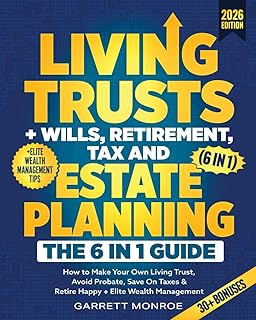
Living Trusts + Wills, Retirement, Tax & Estate Planning – The 6-in-1 Guide (4.5 stars, $24.97) covers charitable strategies alongside core estate planning.
Nolo’s Guide to Estate Planning (4.7 stars, $27.89) is a comprehensive legal reference.

Estate Planning For Dummies (4.3 stars, $20.99) offers an accessible overview.

For organizing your final wishes, I’m Dead, Now What? Planner (4.6 stars, $11.63) helps you document everything, including charitable bequests.

Frequently Asked Questions
What is the best way to leave money to charity in my will?
The simplest method is a specific bequest: naming the charity, the gift amount or percentage, and the charity’s legal name and address. You can also leave a percentage of your residual estate or a specific asset. Using a living trust can avoid probate delays. For most people, a percentage bequest is flexible because it adjusts with your estate’s value.
Can I set up a charitable trust without a lawyer?
While you can find templates online, charitable trusts (CRTs and CLTs) involve complex tax calculations, IRS regulations, and state law compliance. It’s highly recommended to work with an estate planning attorney and a CPA. The upfront cost saves far more in mistakes and tax penalties.
How does a donor-advised fund work after I die?
You can name successor advisors (often family members) to recommend grants from your DAF. The fund itself continues to exist. Some DAF sponsors allow you to leave instructions for how grants should be made in perpetuity. This is a hands-off way to ensure giving continues.
What happens if I name a charity that no longer exists?
The gift may fail, or a court could direct the funds to a similar charity. To avoid this, name the charity’s specific IRS designation or include a “failover” clause that gives the executor authority to choose a charity with a similar mission.
Are charitable bequests subject to state taxes?
Generally, charitable bequests are deductible from state estate or inheritance taxes in states that impose them, but rules vary. States like Pennsylvania and New Jersey have inheritance taxes, and charitable transfers are exempt. Always confirm with a local attorney.
Should I tell my children about my charitable plans?
Yes. Open communication reduces the chance of disputes and helps your family understand your values. You don’t have to share exact dollar amounts, but explaining why you support certain causes can inspire them to continue your legacy.
Can I change my charitable estate plan later?
If you use a revocable living trust or will, yes — you can change beneficiaries and bequests at any time. Charitable trusts (CRTs, CLTs) are irrevocable once funded, so you must be certain before contributing.
What is the maximum I can give to charity tax-free in my will?
There is no cap on charitable bequests. You can leave your entire estate to charity. The estate tax charitable deduction is unlimited. However, if you have heirs you want to provide for, you’ll need to balance gifts within the estate tax exemption.
How does donating crypto to charity work in an estate plan?
You can include cryptocurrency in a will or trust, naming a charity as beneficiary. The charity must be able to accept crypto. Consider using a DAF that supports digital assets, or a specific crypto-gifting platform. Capital gains tax is avoided when the donation is made from the estate.
What are the downsides of a private foundation?
Private foundations have high setup costs (legal fees, filing fees), annual IRS Form 990-PF filings, excise taxes on net investment income (1.39%), and a 5% minimum annual payout requirement. They also lack the anonymity of a DAF. For most estates under $5 million, a DAF is more efficient.
Final Thoughts
Charitable giving in estate planning transforms a financial document into a reflection of your heart. Whether you choose a simple bequest, a charitable trust, or a donor-advised fund, the key is to start early and review often. The tools are flexible, the tax benefits are real, and the impact — on your family, your community, and the world — is immeasurable.
Don’t leave your legacy to chance. Work with a qualified estate planning attorney and a financial advisor who understands charitable strategies. And if you’re a business owner, consider how your company’s succession plan can incorporate philanthropy. See Estate Planning for Small Business Owners: Succession, Buy-sell Agreements, and Continuity.
Your legacy is more than assets. It’s the difference you make. Start planning today.