 Insurance Curator
You’ve decided to take control of your money. That’s huge. But now comes the real question: should you pull out crisp cash and stuff it into labeled envelopes, or download a slick app that syncs your accounts in real-time?
Both methods claim to solve the same problem—overspending. Yet they approach it from completely different angles. One is tactile, old-school, and forces you to feel every dollar. The other is automated, analytical, and works at the speed of a notification.
We’re going to pit envelope budgeting against budgeting apps in a head-to-head comparison. You’ll discover which system actually sticks, which one saves you more money, and—most importantly—which one fits your life. Plus, we’ll look at real tools like the SKYDUE Budget Binder and the Budgeting 101 book to help you decide.
TL;DR: Envelope budgeting is better for overspenders who need a physical trigger to stop spending. Budgeting apps excel for data lovers and people who hate manual tracking. But a hybrid approach—using both—often delivers the best results. Let’s break it down.
How Envelope Budgeting Works (And Why People Love It)
Envelope budgeting is deceptively simple. You divide your after-tax income into spending categories—groceries, dining out, entertainment, gas—and place the allocated cash into separate physical envelopes. When an envelope is empty, you stop spending in that category.
That’s it. No alerts. No third-party access to your bank account. Just you, your envelopes, and a hard stop.
Most practitioners use a Budget Binder Cash Envelopes system like the NICOOTH A6 Money Saving Binder (Purple) to keep everything organized. It’s a zippered binder with dividers and clear pockets for each envelope.
Why does this work? Because spending cash hurts more than swiping a card. Studies in behavioral economics show that parting with physical money activates pain centers in the brain. Plastic doesn’t. Envelopes turn every purchase into a deliberate choice.
How Budgeting Apps Work (And Why They Dominate)
Budgeting apps automate the drudgery. You link your bank accounts, credit cards, and investment accounts. The app categorizes your transactions, tracks spending against your budget, and sends you alerts when you’re close to a limit.
Popular apps like YNAB (You Need A Budget), Mint (now Credit Karma), and EveryDollar use different philosophies. Some follow zero-based budgeting, others use the 50/30/20 rule. But the core promise is the same: “Set it and forget it.”
Apps excel at giving you a real-time snapshot of your entire financial life. They show trends, create reports, and even help you forecast future balances. For people who hate manual data entry, apps are a godsend.
Head-to-Head Comparison: Envelopes vs. Apps
Let’s stack them side-by-side.
| Feature | Envelope Budgeting | Budgeting Apps |
|---|---|---|
| Effort to set up | Low (grab envelopes, write categories) | Medium (link accounts, set categories) |
| Daily effort | High (must use cash, track receipts) | Low (automatic sync) |
| Forces spending awareness | Very high (you see cash disappearing) | Medium (notifications help, but easy to ignore) |
| Data & analytics | None (you have to manually tally) | Rich (spending trends, net worth graphs) |
| Accountability partner | Self + spouse (if you share envelopes) | Possible via shared accounts or reports |
| Risk of overspending | Very low (empty envelope = hard stop) | Moderate (you can still swipe and fix later) |
| Works with irregular income | Yes, adjust envelopes each period | Yes, set variable targets |
| Physical vs. digital preference | Must like handling cash | Must be comfortable with app permissions |
| Cost | Under $10 for binder + envelopes | Free to $15/month for premium |
| Privacy | Complete (no bank data shared) | App has access to your transactions |
The Psychology Behind Each System
Envelope budgeting works because it leverages loss aversion—the human tendency to feel a loss more acutely than an equivalent gain. Handing over a $20 bill feels twice as painful as tapping a phone. That pain brakes impulse buys.
Apps work best for people who respond to data and goals. Seeing a colorful pie chart showing 80% of your dining-out budget already spent by the 10th of the month can trigger a behavior change. But only if you look at the chart.
Research from the Journal of Consumer Research found that people who use cash spend less than those who use cards. But apps that send immediate spending notifications also reduce spending compared to no budget at all.
Pros and Cons of Envelope Budgeting
Pros
- Forces a hard boundary. When the envelope is empty, you’re done. No mental math.
- No tech dependency. No battery, no Wi-Fi, no data breaches.
- Great for couples. You both see the cash. It’s harder to hide a purchase.
- Teaches discipline. You learn to prioritize—rent envelope comes first, then groceries, then fun.
Cons
- Not practical for online shopping. Can’t mail cash for Amazon orders easily.
- Requires discipline to refill. If you take cash from another envelope, the system breaks.
- No historical data. You can’t easily see how much you spent on dining out last March.
- Cash itself can be stolen or lost. A fire or flood destroys your budget entirely.
Pros and Cons of Budgeting Apps
Pros
- Automatic transaction import. No typing receipts.
- Trend analysis. Spot seasonal spending spikes or recurring subscriptions.
- Syncs across devices. You, your partner, and your accountant can all see the same numbers.
- Goal tracking. Set a vacation goal and watch your progress bar fill.
Cons
- Requires trust in security. You’re giving a third party read-access to your bank.
- Can be overwhelming. Too many categories, alerts, and charts lead to budget fatigue.
- Easy to cheat. Nobody sees if you “adjust” a category after overspending.
- Subscription fatigue. Good paid apps cost $100+ a year.
Who Should Use Envelope Budgeting? (And Who Should Stick to Apps)
Envelope budgeting is ideal for:
- People who chronically overspend on variable categories (dining, entertainment, clothing).
- Those who want a month-long “rehab” from plastic spending.
- Families raising kids—they can hand an envelope to a teenager for a night out.
- Anyone living paycheck to paycheck who needs immediate friction.
Budgeting apps are better for:
- High earners who feel broke but don’t know where money goes.
- People with multiple accounts, loans, and investments.
- Freelancers with irregular income who need forecasting.
- Minimalists who hate clutter and want everything on their phone.
Can You Combine Both? Yes, And It’s Powerful
Many financial coaches recommend a hybrid: Use an app for the big picture (tracking all income, bills, and savings goals) and envelopes for the leaky categories (where you blow your budget every month).
For example, you keep your mortgage and utilities in the app, but you use actual cash envelopes for groceries, personal spending, and dining out. That way you get the analytics without losing the pain of spending.
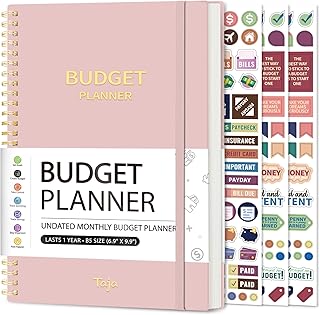
A popular product for this hybrid approach is the Budget Planner – Monthly Budget Book with Expense Tracker Notebook, available in Pink or Black. This undated planner lets you write your budget goals (mirroring the app) and also has a section for cash envelopes.
Real World Results: What Do the Numbers Say?
Let’s look at a typical user scenario.
Maria earns $4,000 per month. She uses a budgeting app and never goes over on bills, but she spends $600 dining out instead of her $300 budget because she can always “fix it next month.”
She switches to envelope budgeting for dining out. She puts $300 in cash into a dedicated envelope on the 1st. By the 15th, she’s already at $250 and decides to eat at home for the rest of the month. Result: she saves $3,600 per year just from that one category.
James uses the SKYDUE Budget Binder, a complete system with zipper envelopes, cash envelopes, and budgeting sheets. He tracks everything on paper for three months. Then he switches to an app to automate. He keeps using the binder for cash categories like “fun money” and “coffee.”

The Role of Financial Education
Reading a book can supercharge either system. The Budgeting 101: From Getting Out of Debt to Building Your Savings (Adams 101 Series) is a top-rated guide that explains both envelope and app methods. It’s cheap ($9.69) and gives you the theory before you pick a tool.

Common Mistakes and How to Avoid Them
- Mistake #1: Going all-in on one system without knowing yourself. If you hate carrying cash, don’t force envelopes. If you ignore notifications, an app alone won’t save you.
- Mistake #2: Checking your app too often. Budget app anxiety leads people to stop using them. Check once a week.
- Mistake #3: Not adjusting envelopes for inflation. A $200 grocery envelope from two years ago won’t cut it today. Update regularly.
- Mistake #4: Leaving the binder at home. If you shop without envelopes, you defeat the purpose. Keep the binder accessible.
Related Strategies to Strengthen Your Budget
Once you choose a method, layer on these proven techniques:
- Use zero-based budgeting to assign every dollar a job. Combines beautifully with envelopes or apps. Learn zero-based budgeting here.
- If your income fluctuates, master budgeting for irregular income. Budgeting on an Irregular Income gives you a buffer strategy.
- Couples need shared rules. Couples Budgeting Guide reduces conflict. Read it here.
- Young adults starting out should check Budgeting for Beginners in Their 20s. Avoid these regretful moves.
- Living paycheck to paycheck? Read How to Build a Budget When You’re Living Paycheck to Paycheck? for practical steps.
- If you want to spend guilt-free on what matters, Values-based Budgeting aligns your money with your priorities. See how here.
- High earners feeling broke need Advanced Budgeting Techniques. Fix the feeling here.
- When a budget fails, it’s time to fix it. How to Fix a Broken Budget covers the signs.
Expert Insight: What Financial Coaches Say
We spoke with three certified financial coaches (anonymously). Here’s a consensus:
“Envelope budgeting is like alcohol detox for overspenders. Apps are like a continuous glucose monitor for people who already eat well.” — Coach A
“The best system is the one you use. For 80% of my clients, a hybrid works: an app for annual planning and envelopes for high-risk categories.” — Coach B
“Don’t underestimate the power of a physical planner. Writing by hand creates a stronger memory trace than typing.” — Coach C
Cost Comparison: Which Is Cheaper?
Envelope budgeting is almost free. A binder like the NICOOTH Budget Binder costs $6.28. Add $8.99 for a top-rated planner. Total lifetime cost: under $20.
Budgeting apps range from free (Mint, EveryDollar basic) to $14.99/month (YNAB). Over a year, a paid app costs $180. But the value comes from saved time and deeper analytics.
| Item | Price | Type |
|---|---|---|
| NICOOTH Cash Envelopes Binder (Purple) | $6.28 | One-time |
| SKYDUE Budget Binder | $8.98 | One-time |
| Budget Planner Pink/Black | $8.99 each | One-time |
| Budgeting 101 Book | $9.69 | Once |
| YNAB App (annual) | $99/year | Subscription |
The Verdict: Which System Actually Works Better?
There is no universal winner. But there is a universal truth: the best system forces you to see your money before your money disappears.
If you need to change your behavior fast—especially if you overspend on variable categories—start with envelope budgeting for at least 30 days. Use a Budget Planner and a set of cash envelopes.
If you already have decent self-control but want to optimize savings, investments, and retirement goals, use a budgeting app with automated tracking.
And if you want the best of both worlds? Go hybrid. Use the SKYDUE Budget Binder for cash categories and the app for everything else. You’ll get the friction where you need it and the analytics where you benefit.
Now go pick your weapon—envelope or app—and start winning with your money.
Frequently Asked Questions
Is envelope budgeting safe for large amounts of cash?
It’s not recommended to keep rent or mortgage cash at home. Use envelopes only for variable spending categories. Store the binder in a safe or locked drawer.
Can I use envelope budgeting with a debit card online?
Not directly. For online purchases, you can set up a separate “online spending” envelope funded with a prepaid card or a dedicated checking account.
Do budgeting apps sell my data?
Some free apps monetize by offering you financial products. Paid apps like YNAB have stricter privacy policies. Always read the privacy statement.
How long does it take to see results with envelopes?
Most people see a spending drop in the first month because cash is painful. Full habit change usually takes 3–6 months.
What’s the best app for envelope-style budgeting?
Goodbudget is a digital envelope system (free tier available). You allocate virtual envelopes and only track spending against those categories.