 Insurance Curator
 Estate planning isn’t just about money — it’s about protecting the people you love. Whether you’re a busy professional, a retiree, or a parent with young kids, the decision between a last will and a living trust can feel overwhelming. Both tools let you pass on your assets, but they work very differently. The right choice depends on your goals, your family dynamics, and how much privacy and control you want.
If you’re just starting to explore your options, a resource like Living Trusts, Wills & Estate Planning for Seniors – The Complete 3-in-1 Guide can help you understand the basics without a costly lawyer. This article will dive deep into the differences, pros and cons, and real-life scenarios so you can decide which path fits your situation best.

What Is a Last Will and Testament?
A last will and testament is a legal document that spells out who gets your property after you die. You name an executor to carry out your wishes, and if you have minor children, you can name a guardian. A will only takes effect when you pass away, and it must go through probate — a court-supervised process that verifies the will and distributes assets.
Probate can take months (sometimes years) and is a matter of public record. That means anyone can look up what you owned and who inherited it. For some families, the cost and delay of probate are minor inconveniences. For others, probate is a nightmare they want to avoid.
What Is a Living Trust?
A living trust is a legal arrangement you create while you’re alive. You transfer your assets into the trust, and you (or a successor trustee you choose) manage those assets. When you die, the successor trustee distributes the assets to your beneficiaries without probate. There are two main types:
- Revocable living trust – You can change or cancel it anytime. You retain full control. Most people use this for probate avoidance.
- Irrevocable trust – You give up control, but it offers asset protection and tax benefits.
Trusts are private — no court filing, no public records. They also cover you if you become incapacitated, because your successor trustee can step in immediately.
Key Differences at a Glance
| Aspect | Last Will | Living Trust |
|---|---|---|
| Takes effect | After death | During life (and continues after death) |
| Probate | Required | Avoided |
| Privacy | Public record | Private |
| Incapacity planning | Not covered | Covers you if you become incapacitated |
| Guardianship of minors | Yes | No (need a will for that) |
| Cost to create | Lower (typically $200–1,000) | Higher (typically $1,500–3,000) |
| Cost to maintain | None (one-time) | May need to transfer assets and update |
| Control | You control via executor | You control as trustee while alive |
| Challenging | Easier to contest | Harder to contest |
Advantages of a Last Will
- Simplicity and low upfront cost. For straightforward estates, a will is quicker and cheaper. You can even use a DIY service like Estate Planning For Dummies to write a basic will for under $25.
- Guardianship for minor children. Only a will lets you name a guardian for your kids. A trust cannot do that. If you have young children, a will is essential.
- Easy to update. You can revoke or amend a will at any time, as long as you follow state signature and witness rules.
- Handles specific bequests. You can give away personal items like jewelry, family heirlooms, or even your pet. Trusts can do this too, but a will is often more natural for one-off gifts.
Internal link: For a step-by-step guide, see Step-by-step Guide to Writing a Legally Valid Will (Even if You’re Not Rich).
Advantages of a Living Trust
- Avoids probate. This is the number one reason people choose a trust. Probate can eat up 3–7% of an estate in fees and take months. A trust lets your heirs receive their inheritance faster.
- Privacy. Wills become public documents. Trusts stay private. If you’re a public figure or simply value discretion, a trust is the way to go.
- Incapacity planning. If you become ill or mentally unable to manage your affairs, your successor trustee can take over without a court-appointed conservator. A will does nothing for incapacity.
- Harder to contest. Because trust assets are not part of the probate estate, it’s much more difficult for disgruntled relatives to challenge your wishes.
- Out-of-state property. If you own real estate in multiple states, a trust avoids separate probate proceedings in each state.
Internal link: Learn more about the different structures in Types of Trusts Explained: Revocable, Irrevocable, Special Needs, and More.
Disadvantages of Each
Disadvantages of a Will
- Probate is public and slow. Your family must wait. Creditors have time to make claims.
- No incapacity protection. If you fall into a coma, your will is useless. A court will appoint a guardian to handle your finances.
- Easier to contest. A will is more vulnerable to challenges based on improper signing, lack of mental capacity, or undue influence.
Disadvantages of a Living Trust
- Higher upfront cost. A living trust is more complex, often requiring a lawyer. However, you can use a guide like Nolo’s Guide to Estate Planning (rating 4.7) to save on legal fees.
- Requires funding. A trust only works if you actually transfer assets into it. Many people set up a trust but forget to retitle their house or bank accounts — defeating the purpose.
- Ongoing maintenance. As you buy and sell property, you must keep the trust funded. It’s not a “set it and forget it” document.
- No guardianship power. You still need a separate will for naming guardians for minor children.
Internal link: If you fail to fund your trust, read Funding Your Trust: What It Means and How to Properly Transfer Assets.
Which One Should You Choose? Real-Life Scenarios
Scenario 1: Young Couple with Modest Assets and Kids
- Best choice: A will plus a guardian nomination. If your estate is under $200,000 and you live in a state with a simple probate process, a will is enough.
- Why: You need guardianship for your children, and probate costs won’t wipe out your assets. Keep costs low now, and consider a trust later as wealth grows.
Scenario 2: Retiree with a Home, Investments, and No Minor Children
- Best choice: A revocable living trust.
- Why: You want to avoid probate for your heirs, keep your affairs private, and ensure a seamless transition if you become incapacitated. The trust will cover your home, bank accounts, and investments.
Scenario 3: Business Owner with Complex Assets
- Best choice: A living trust (often an irrevocable trust for asset protection).
- Why: Probate can disrupt business operations. A trust provides continuity and privacy. You may also want a pour-over will to catch any assets not titled in the trust.
Scenario 4: Minimal Assets, No Family Drama
- Best choice: A simple will. If your estate is under your state’s small-estate limit (e.g., $50,000 in many states), probate may be waived anyway.
- Why: A trust would be overkill. Just write a will, name an executor, and you’re done.
Expert insight: “Most people benefit from a combination — a living trust for privacy and probate avoidance, plus a pour-over will to handle guardianship and any leftover assets. It’s not either/or,” says certified estate planner Martha Collins.
Can You Have Both? Yes — Here’s How They Work Together
You should almost always have a pour-over will alongside your living trust. This will acts as a safety net. If you forget to transfer a bank account or a car into the trust, the pour-over will directs those assets into the trust after your death. The downside? Those assets still go through probate, but at least they end up in the trust.
- Trust + pour-over will is the standard package for comprehensive estate planning.
- Trust + separate will is also possible if you want to give specific personal items directly to individuals.
Internal link: Want to know how to choose the right executor? See How to Choose an Executor for Your Will and What Their Job Really Involves?.
How to Get Started
Step 1: Take Inventory of Your Assets
List everything: real estate, bank accounts, retirement accounts, insurance policies, vehicles, business interests. Note which assets have beneficiary designations (like life insurance and retirement accounts) — those pass outside of wills and trusts.
Step 2: Decide on Guardians for Minor Children
If you have kids under 18, pick a guardian. This decision alone will influence whether you need a will even if you also use a trust.
Step 3: Choose Your Executor and Trustee
Your executor handles the will; the trustee manages the trust. They can be the same person. Pick someone responsible, organized, and willing to serve.
Step 4: Draft the Documents
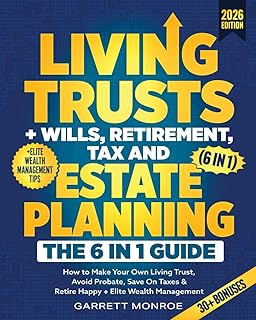
You can use online services, books, or an attorney. For most people, a reputable book like Living Trusts + Wills, Retirement, Tax & Estate Planning – The 6-in-1 Guide (rating 4.5) offers an affordable, thorough roadmap.
Step 5: Fund Your Trust
If you chose a living trust, transfer assets into it. This means changing titles on real estate, retitling bank and brokerage accounts, and naming the trust as beneficiary for certain assets.
Step 6: Store Documents Safely
Keep originals in a fireproof safe, with copies to your executor/trustee. Also consider a document organizer like I’m Dead, Now What? Planner (rating 4.6) to help your family locate everything.
Internal link: Need storage tips? See How to Store and Share Your Will and Trust Documents So They’re Found When Needed?.
Real-Life Example: The Smiths vs. The Jacksons
- The Smiths — Married, two teenage kids, own a house worth $400,000, two cars, and $150,000 in investments. They created a living trust, funded it with the house and brokerage accounts, and wrote a pour-over will. Their state probate would have cost $12,000 and taken 10 months. Instead, their kids received the trust assets in six weeks with zero court involvement.
- The Jacksons — Same assets, but they only had a will. Probate took over a year, added $15,000 in fees, and their entire financial details were published online. They named a guardian in their will, but the probate delay caused stress for their children.
The difference? Privacy, speed, and cost.
Common Mistakes to Avoid
- Not funding the trust. It’s the most frequent error. A trust with no assets is pointless.
- Naming minor children as direct beneficiaries without a trust. If you leave money to a minor via a will, a court manages it until age 18. Use a trust for minors instead.
- Failing to update beneficiaries on retirement accounts. Your will or trust may say one thing, but if the beneficiary form says something else, the form wins.
- Using DIY online wills for complex estates. They can be legally valid, but they often miss state-specific requirements. For complex situations, consult a professional.
Internal link: Are DIY wills safe? Read DIY Online Wills: Are They Safe or a Legal Disaster Waiting to Happen?.
Frequently Asked Questions
1. Which is cheaper, a will or a living trust?
A will is cheaper upfront (often under $500), while a trust costs $1,500–$3,000 or more. However, a trust saves probate costs, which can be 3–7% of the estate value.
2. Does a living trust avoid estate taxes?
No. A revocable living trust does not reduce estate taxes. The same tax rules apply as if you owned the assets directly. Irrevocable trusts can help, but they require you to give up control.
3. Can I change my living trust after I create it?
Yes, if it’s a revocable living trust, you can amend or revoke it anytime. Irrevocable trusts generally cannot be changed.
4. Do I still need a will if I have a living trust?
Yes. You need a pour-over will to catch any assets not in the trust and to name guardians for minor children. A trust alone cannot do those things.
5. What happens to my trust if I move to another state?
Most states recognize revocable living trusts created in other states. However, you may need to update your pour-over will to comply with new state laws. Consult an attorney.
6. Who should I name as trustee?
A trusted family member or close friend. For complex estates, consider a corporate trustee (bank or trust company). They charge fees but provide professional management and liability protection.
7. How long does probate take if I only have a will?
It varies by state and complexity. Simple estates can take 6–9 months; complex ones can stretch 1–3 years. Courts prioritize known debts and tax filings.
8. Can I name my pet in my will or trust?
You cannot leave money to a pet directly because animals can’t own property. Instead, create a pet trust to set aside funds for their care. A will can express wishes but a trust is more enforceable.
Internal link: Learn more about Pet Trusts and Wills for Pet Owners: Ensuring Your Animals Are Cared for.
9. Is a living trust better for blended families?
Yes. A trust can dictate exactly when stepchildren or biological children receive assets, and it avoids the risk of a second spouse disinheriting your kids. Talk to an estate planner.
10. Do I need an attorney to create a living trust?
Not necessarily. Books like Nolo’s Guide to Estate Planning (rating 4.7) provide forms and instructions. However, if your estate is large, has business interests, or involves special needs beneficiaries, legal advice is wise.
Final Verdict: Last Will vs. Living Trust
The truth is, there’s no single “best” choice. A will is simpler, cheaper, and essential for guardianship. A living trust offers privacy, probate avoidance, and incapacity protection — but at a higher cost and with ongoing maintenance.
For most people, the ideal plan includes both: a revocable living trust as the primary vehicle for your assets, and a pour-over will as a safety net. That combination gives you the best of both worlds.
Start by educating yourself. Use resources like the Estate Planning For Dummies book to build your knowledge, then consult a qualified attorney if your situation is complex.
Your family’s future is worth the effort. Whether you choose a will, a trust, or both, the most important step is to begin — today.
Internal links for further reading:
- Living Will and Healthcare Directives: Making Medical Wishes Legally Clear
- How to Update a Will or Trust after Major Life Changes?
- Trusts for Minor Children: How to Control When and How They Receive Money
- The Role of a Trustee: Duties, Liabilities, and How to Pick the Right Person
- Tax Implications of Different Trusts: What Families Need to Know before Setting One up
- Community Property, Wills, and Trusts: Estate Planning in Community Property States
- What Happens if You Die Without a Will? Intestacy Laws Explained by State?