 Insurance Curator
Build an exam error log with one row per missed question. Record what you did, identify the first point where your answer went wrong, and assign one primary label: knowledge gap, misread question, or execution error. Give each row a specific practice task and a date to test the fix on a fresh question.
- Keep your original answer and scratch work so you can diagnose the mistake before reading the solution.
- Start with five missed questions from one practice set rather than logging an entire semester.
- Record points lost as well as the error type so one costly mistake doesn’t disappear among several small ones.
- Count a fix as working when you can solve a fresh question without notes or hints.
Table of Contents
Toggle
- What should you put in an exam error log?
- How do you tell the three error types apart?
- How do you turn each error into a practice task?
- When should you retest a mistake?
- What does a completed exam error log entry look like?
- What if the same mistakes keep showing up?
- Which study guides and lesson plans can supply fresh questions?
- Common questions
What should you put in an exam error log?
An exam error log needs enough detail to reconstruct a mistake and check the fix. A notebook or spreadsheet works. If you use a spreadsheet, keep the three labels consistent so you can filter by type later.
- Set up seven fields: question reference, skill tested, points lost, evidence from your attempt, primary error type, practice task, and retest date and result. A question reference can be as short as “Unit 3 quiz, Q6.” For evidence, quote the line where you went wrong instead of copying the whole prompt.
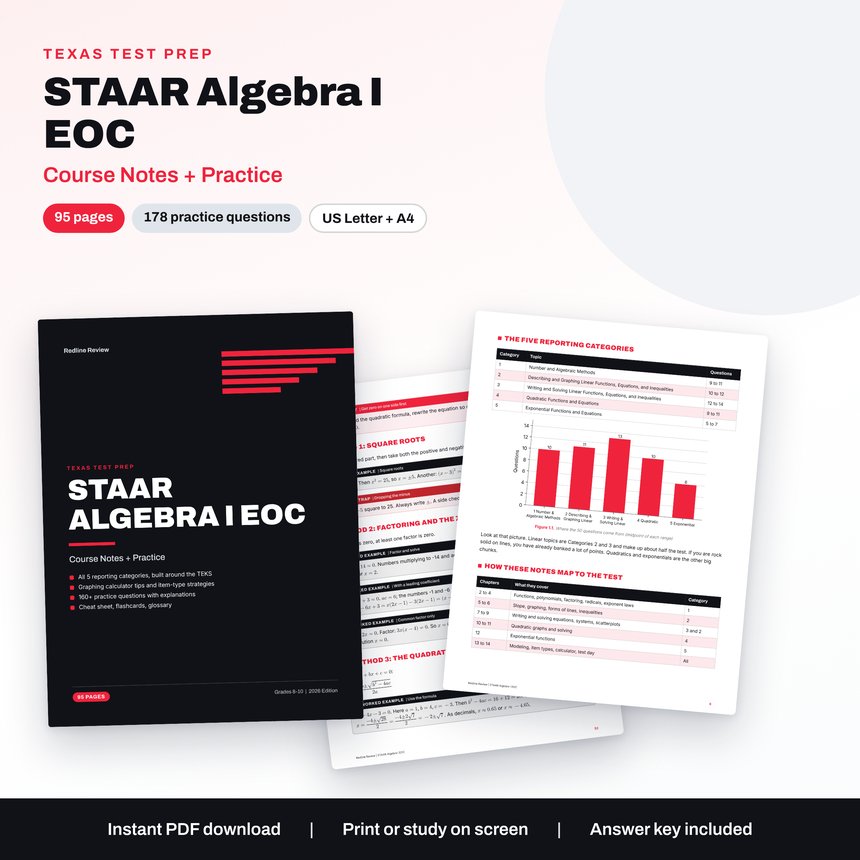
This STAAR Algebra I EOC study guide covers all five reporting categories with clear steps, worked examples, and plenty of practice.
- 14 chapters
- Five reporting categories
- 178 explained practice questions
How do you tell the three error types apart?
The three exam error types tell you where the answer broke down: in what you knew, what you thought the question asked, or what you did after choosing the right approach.
- Retry before reading the explanation. Restate what the prompt asks, solve it without notes, and compare your retry with the original work. Use the first breakdown supported by that evidence.
| Error type | What it means | What it looks like |
|---|---|---|
| Knowledge gap | A knowledge gap is a missing or misunderstood fact, concept, or method. | You correctly identify that the prompt asks for slope, but you can’t explain how to find it from two points. |
| Misread question | A misread question is an error in interpreting the requested task, condition, or format. | You know how to calculate slope and intercept, but give the intercept when the prompt asks for slope. |
| Execution error | An execution error is a mistake made while carrying out a method you know on a question you understood. | You use the correct slope formula, then copy a 7 as a 1 in the calculation. |
How do you turn each error into a practice task?
An exam error log works best when the practice task targets the cause. Relearning a formula won’t help much if you already knew it and answered for the wrong quantity.
- Write a task you can finish and check.
- Knowledge gap: Review one worked slope example. Close the notes, write the formula from memory, and explain which differences belong in the numerator and denominator.
- Misread question: Take four prompts and write the requested output before solving each one. For example, write “slope only” at the top of your work.
- Execution error: Add a check at the point of failure. If you copied a coordinate incorrectly, compare both coordinates with the prompt before you subtract.
When should you retest a mistake?
Retest an exam error on a fresh question a day or two after practicing, if your schedule allows. A new question checks whether you can apply the fix without remembering the original answer.
- Record what happened without hints. Mark the row “passed” if you got the answer right and used the intended check or method. If you missed it again, record the new evidence. For an error that only appears under time pressure, make the next check a short timed set.
What does a completed exam error log entry look like?
A completed exam error log entry connects the original work to a test of the fix. In this Algebra I example, the prompt asks for the greater of two solutions to ((x-2)(x-5)=0). The student correctly finds 2 and 5, then submits 2.
- Reference, skill, and points lost: Practice set Q12, solving factored quadratics, 1 point.
- Evidence and diagnosis: Both roots were correct in the scratch work. On an unaided retry, the student notices “greater” and selects 5. The primary label is misread question.
- Practice task: On four prompts with two valid solutions, mark the selection word and compare the final answer with it before submitting.
- Retest result: Two days later, a fresh question asks for the lesser root of ((x+3)(x-4)=0). The student marks “lesser” and submits −3 without a hint. The row passes.
For more Algebra I practice, the Isolate It Texas STAAR Algebra I EOC Study Guide covers quadratics and includes 178 practice questions with explanations. Save some questions for retesting rather than working through every item during review.
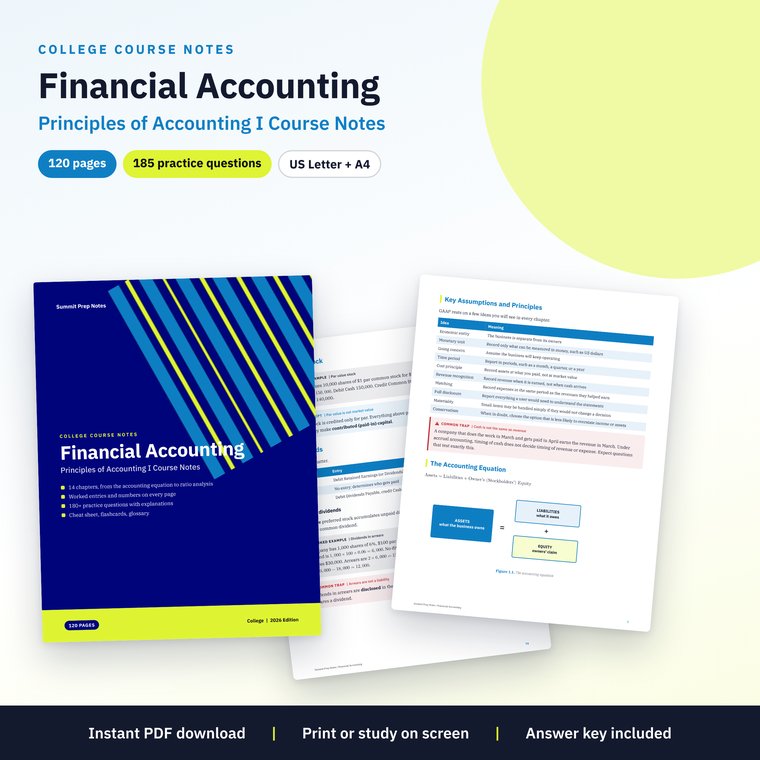
This financial accounting study guide covers a full first-semester course, from the accounting equation and journal entries to bonds, stock, cash flows, and ratio analysis.
- 14 chapters
- Worked journal entries
- 185 explained practice questions
What if the same mistakes keep showing up?
Repeated exam errors call for a narrower practice task or a closer look at the evidence. If your log says “careless” three times, replace each entry with the exact action you took, such as “rounded before the final step.”
If two labels fit, use the first error that changed the answer. Missing the word “except” comes before picking the wrong option. If you then realize you don’t know why the exception matters, note the knowledge gap separately and give it its own task.
Which study guides and lesson plans can supply fresh questions?
Study guides and lesson plans are useful when they give you another way to test the same skill. Choose material that matches the error: a worked example for a gap, varied wording for a misread, or a fresh problem for an execution check.
For accounting, use the worked entries in the Trial Balance Financial Accounting Study Guide to review why an account is debited, then try a different transaction without notes.
For marketing, the Plainmark Principles of Marketing Study Guide covers both BCG and Ansoff. If you confuse the two models, compare them, then explain which one fits a fresh scenario.
For Praxis 5622, use the worked cases in the Slatewise Praxis 5622 Study Guide if you know the teaching strategy but keep leaving the justification out of constructed responses.
Classroom resources for targeted reteaching
For whole-class planning, start with High-Quality Lesson Planning (Quick Reference Guide). For subject-specific practice, match the resource to the pattern you see: Remedia’s Where the Red Fern Grows teaching guide for comprehension, the Orton-Gillingham Lesson Planning Companion Guide for decoding, or Middle School ESL Lesson Plans for the Whole Year for academic language.
- Use High-Quality Lesson Planning (Quick Reference Guide) when planning a short reteach and a separate exit question.

- Use Remedia’s Where the Red Fern Grows teaching guide to practice distinguishing plot recall from supporting an inference.

- Use the Orton-Gillingham Lesson Planning Companion Guide for a fresh decodable phrase after practicing a missed word pattern.

- Use Middle School ESL Lesson Plans for the Whole Year when grades 6–8 students need practice with academic directions such as “compare” and “explain.”

Common questions
An exam error log can also handle guesses, blanks, partial credit, and tests you aren’t allowed to keep.
Should I log a correct guess?
Yes. Record a correct guess as a near miss with zero points lost. If you can’t explain the answer without seeing the options, give yourself a similar question to answer in your own words before deciding the skill is secure.
What if I ran out of time and left a question blank?
Mark the blank as unclassified and note where time ran out. Try the question untimed. If you solve it unaided, investigate pacing by checking how long you spent on earlier items. If you still can’t start, check for a knowledge gap.
How should I handle partial credit?
Record the points you actually lost and the first missing or incorrect step. If you earned two of three points for a correct answer without a justification, check whether you overlooked the instruction or couldn’t supply the reasoning. Those call for different practice tasks.
Can I keep a log if I can’t take the exam home?
Yes. Follow the exam’s rules and record only what you’re allowed to retain. A skill label and your own description, such as “compared totals instead of rates,” are enough to find a fresh practice item without copying a restricted prompt.
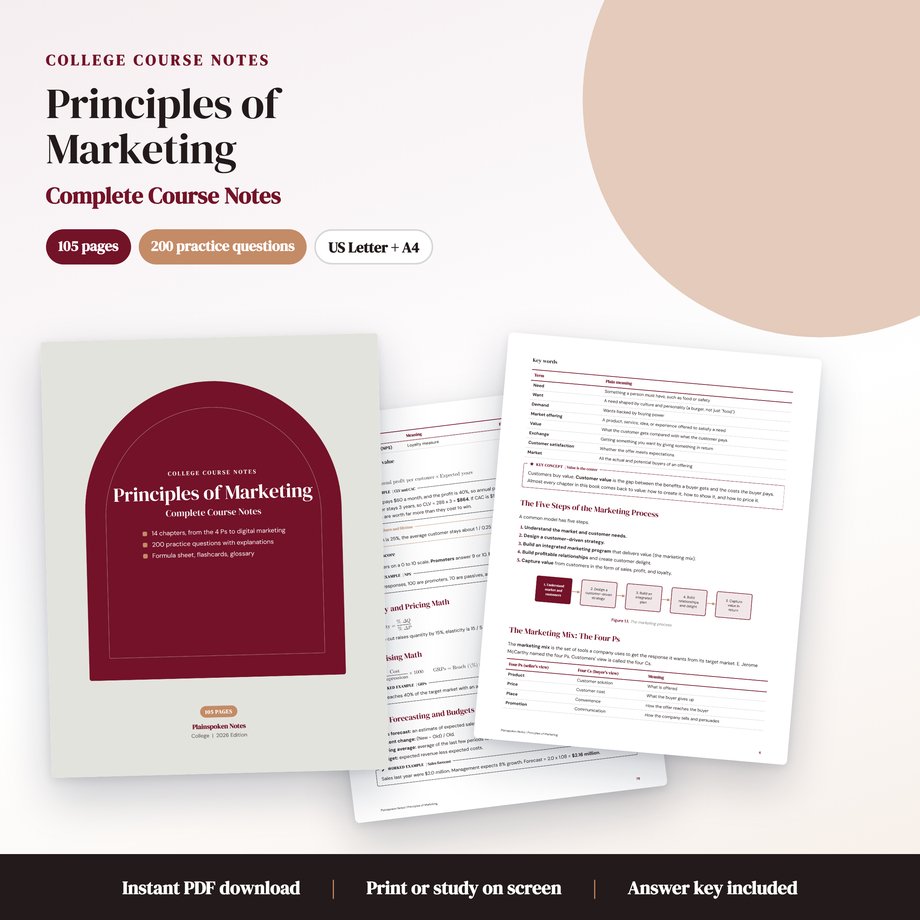
This principles of marketing study guide follows the standard intro course from the four Ps to digital marketing, in plain language.
- BCG and Ansoff diagrams
- 200 explained practice questions
- 60-question practice exam