 Insurance Curator
A lesson plan template should include the class and duration, a measurable learning objective, and a way to check whether students met it. Add the materials, timed teaching and practice activities, student supports, and a next step. Fill in the objective and assessment first so every activity prepares students to show what they learned.
- One measurable objective is a useful starting point for a single class period.
- An exit ticket is a short task students complete before leaving to show what they can do on their own.
- A lesson plan guides instruction, while a study guide gives students material to review and practice.
- A 45 minute period needs time for directions, transitions, and a final check as well as teaching.
For a planning reference, consider High-Quality Lesson Planning (Quick Reference Guide). For subject examples, the Remedia teaching guide to Where the Red Fern Grows covers reading comprehension, the Orton-Gillingham Lesson Planning Companion Guide supplies decoding practice, and Middle School ESL Lesson Plans for the Whole Year supplies academic language units.
Table of Contents
Toggle
- Copy the lesson plan template
- Fill in the fields in order
- Read the completed Algebra I example
- Fix pacing and assessment problems
- Choose practice for study guides and lesson plans
- Find planning references by subject
- Common questions
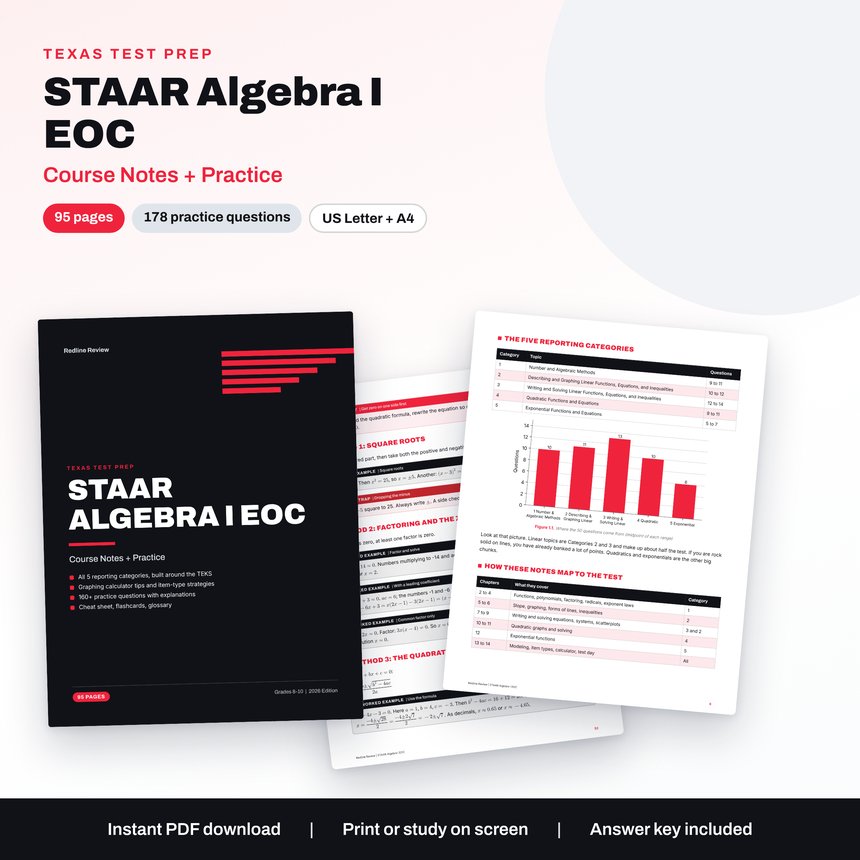
This STAAR Algebra I EOC study guide covers all five reporting categories with clear steps, worked examples, and plenty of practice.
- Five reporting categories
- 14 chapters
- 178 practice questions
What goes in a lesson plan template?
A lesson plan template records what students will learn, what they’ll do, and how you’ll check their work. Copy these fields into a document and leave room for one or two lines per field.
- Class details: Grade or course, topic, date, and minutes available.
- Objective and standard: What students will do by the end, plus the curriculum standard if required.
- Evidence of learning: The task students will complete and what counts as a successful response.
- Materials and setup: Readings, handouts, equipment, and anything to prepare before class.
- Teaching sequence: Opening task, demonstration, guided practice, independent practice, and closing check, with minutes for each.
- Student supports: An access support, such as a labeled diagram, and an extension for students who are ready.
- Follow-up: What you’ll reteach or extend after reviewing the work.
How do you fill in a lesson plan template?
Fill in a lesson plan template in the order you’ll make decisions, not the order students will experience the class. Decide what success looks like before you plan the opening activity.
- Name the skill. A learning objective is a statement of what students should be able to do. Replace “understand character motivation” with “explain a character’s decision using one detail from the chapter.”
- Write the final check. Ask students to explain a different decision from the chapter. A successful response names a plausible motive and connects it to a specific detail.
- Plan practice that matches the check. Model one response, build a second with the class, then have students write a third alone. If discussion runs long, shorten it rather than dropping the independent response.
- Choose materials and supports. List page numbers, print the excerpt, and offer a sentence starter such as “The character chose ___ because ___.” Keep the evidence requirement the same.
- Plan a response to the results. If students can name a motive but cite no evidence, start the next lesson by comparing two details and deciding which better supports the claim.
What does a completed lesson plan look like?
A completed Algebra I lesson plan uses the same skill for modeling, practice, and assessment: solving a two-step equation and checking the solution by substitution. The 45 minutes below include time for students to work alone.
- Class details and objective: Algebra I, 45 minutes. Students will solve two-step linear equations and verify a solution in the original equation.
- Evidence of learning: On the exit ticket, solve
4x + 3 = 19and show that substitutingx = 4gives19 = 19. - Materials and supports: Whiteboards, an equation handout, and an exit slip. Provide a worked example with each operation labeled. For an extension, ask students to write an equation with a solution of
−3. - Teaching sequence: Spend 5 minutes reviewing inverse operations, 8 modeling
3x + 5 = 20, 12 solving two problems together, 15 on independent practice and feedback, and 5 on the exit ticket. - Follow-up: Sort exit tickets by error. If students found
x = 4but didn’t verify it, open the next class by substituting a correct answer and an incorrect answer into the same equation.
How do you fix a lesson plan that isn’t working?
Fix a lesson plan by identifying what went wrong: the task didn’t measure the objective, the timing didn’t hold, or students got stuck before they could practice.
- The check measures recall instead of application. If the objective is to distinguish two policies, use a short case rather than asking for definitions. A business class could use property insurance vs. general liability to classify a damaged storefront and a customer’s injury.
- The discussion runs over. Cut the second whole-class example before you cut the five minutes reserved for the exit ticket.
- Students can’t start independently. If students can subtract the constant but stall at
4x = 16, model the division step again. Then give them a fresh equation instead of asking them to copy the solution.
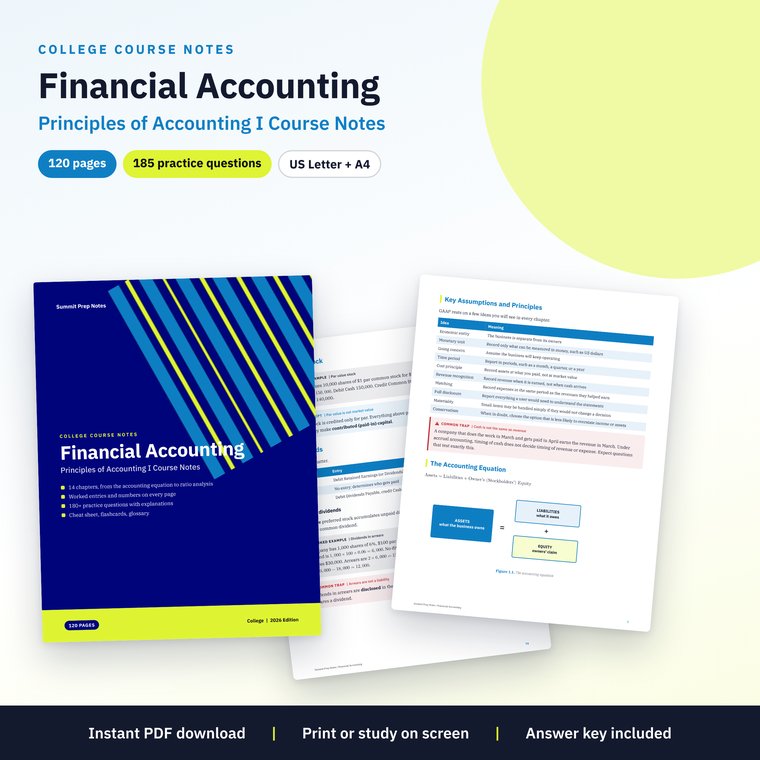
This financial accounting study guide covers a full first-semester course, from the accounting equation and journal entries to bonds, stock, cash flows, and ratio analysis.
- 14 chapters
- Worked journal entries
- 185 practice questions
How do study guides fit into lesson plans?
A study guide is a review resource students can use without the teacher leading each step. Assign a worked example and a few matching questions instead of handing out an entire chapter.
For Texas Algebra I end-of-course review, the Isolate It Texas STAAR Algebra I EOC Study Guide offers worked examples and questions with explanations across all five reporting categories.
For a college accounting lesson on journal entries, use a worked entry from the Trial Balance Financial Accounting Study Guide. Then change the dollar amount and ask students to record the transaction without the model.
For an introductory marketing lesson, pair the segmentation, targeting, and positioning material in the Plainmark Principles of Marketing Study Guide with a reading on pet insurance branding strategies. Ask students to identify the intended customer and cite one clue.
For a teacher preparation session, use a worked case from the Slatewise Praxis 5622 Study Guide. Ask candidates to recommend a teaching response and support it with one fact from the case.
Which planning references fit your subject?
Choose a lesson planning reference by the field you need to fill. A guide can supply an example, a text, or a practice task; you’ll still need to set the objective and check it with your students.
General planning and reading comprehension
Use High-Quality Lesson Planning (Quick Reference Guide) as a planning reference when reviewing whether your exit ticket measures the objective.

For a middle or high school novel unit, use the Remedia teaching guide to Where the Red Fern Grows to select a comprehension task that fits the chapter you’re teaching.

Decoding and academic language
Choose a word list and a decodable sentence from the Orton-Gillingham Lesson Planning Companion Guide to practice the same spelling pattern in isolation and in a sentence.

Use Middle School ESL Lesson Plans for the Whole Year for academic language unit material in grades 6 to 8. For a consumer vocabulary lesson, pair a short excerpt from a guide to renters insurance in Arizona with practice using “covers” and “doesn’t cover.”

Common questions
Can one lesson plan cover two class periods?
One lesson plan can cover two periods when both build toward the same objective. Give each day its own timing and check. For example, use annotated sources to check preparation on day one and a paragraph that compares those sources to assess the objective on day two.
What should a substitute teacher’s lesson plan include?
A substitute teacher’s lesson plan needs the regular teaching sequence plus room routines, material locations, and directions for collecting work. Add a task students can start without a new explanation, such as correcting two sample equations with a worked example.
Does every lesson plan need homework?
A lesson plan doesn’t need homework when classroom practice gives you enough evidence to decide what comes next. If you assign homework, give it a purpose, such as three review problems to check whether students can still apply yesterday’s method.
What changes when you turn a lesson plan into an online lesson?
An online lesson plan needs to say where students find instructions, where they submit work, and when they’ll get feedback. Before publishing, open the lesson in student view and try the submission step yourself. If the task depends on a video, provide a written example students can use instead.
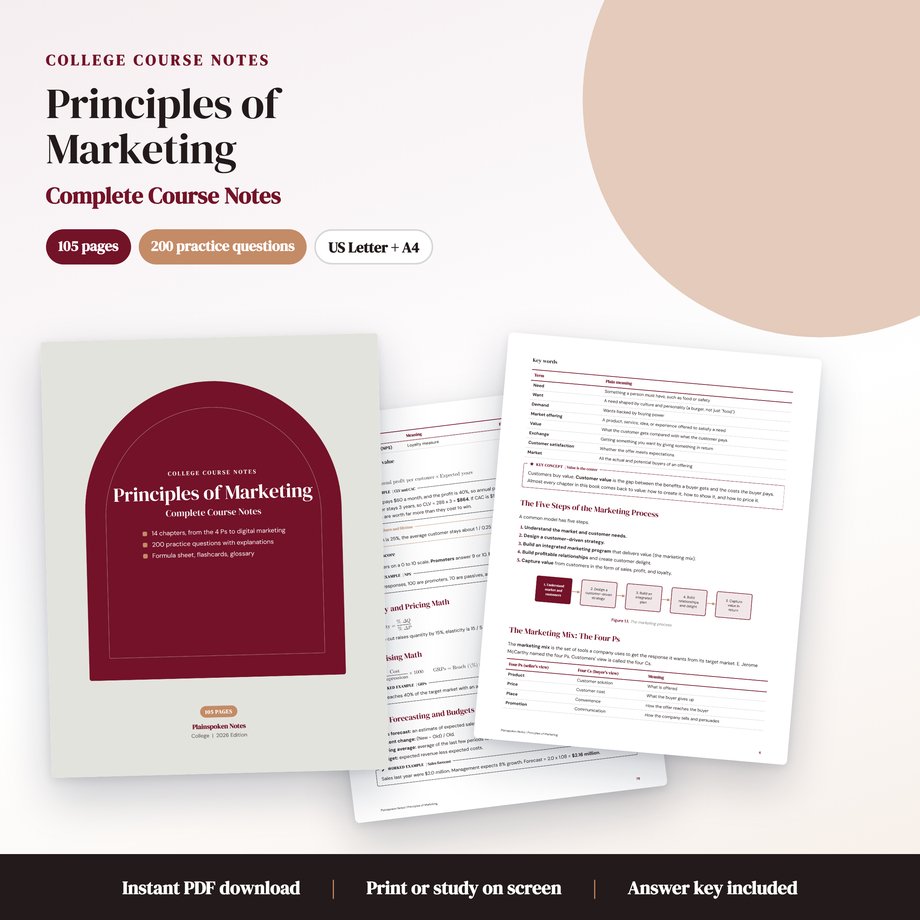
This principles of marketing study guide follows the standard intro course from the four Ps to digital marketing, in plain language.
- Marketing model diagrams
- 200 practice questions
- 60-question practice exam