 Insurance Curator
Build a study guide by listing what the exam covers, turning each topic into a question or task, and keeping the answers separate so you can test yourself. Use the study guide template to track missed questions and schedule another attempt. Start with one worked example and one practice task per topic.
- An exam blueprint is a topic outline that may also show how much each area counts toward your score.
- A useful study guide entry has a prompt, a way to check the answer, and a date to try it again.
- If a topic is worth many points and you can’t answer a sample question without notes, study it first.
- For open-book exams, practice finding and applying information within the time limit rather than copying whole pages into your guide.
Table of Contents
Toggle
- How do you build a study guide from scratch?
- What does a completed study guide entry look like?
- How do you fix a study guide that isn’t helping?
- When is a ready-made study guide worth using?
- How do teachers turn lesson plans into study guides?
- Common questions
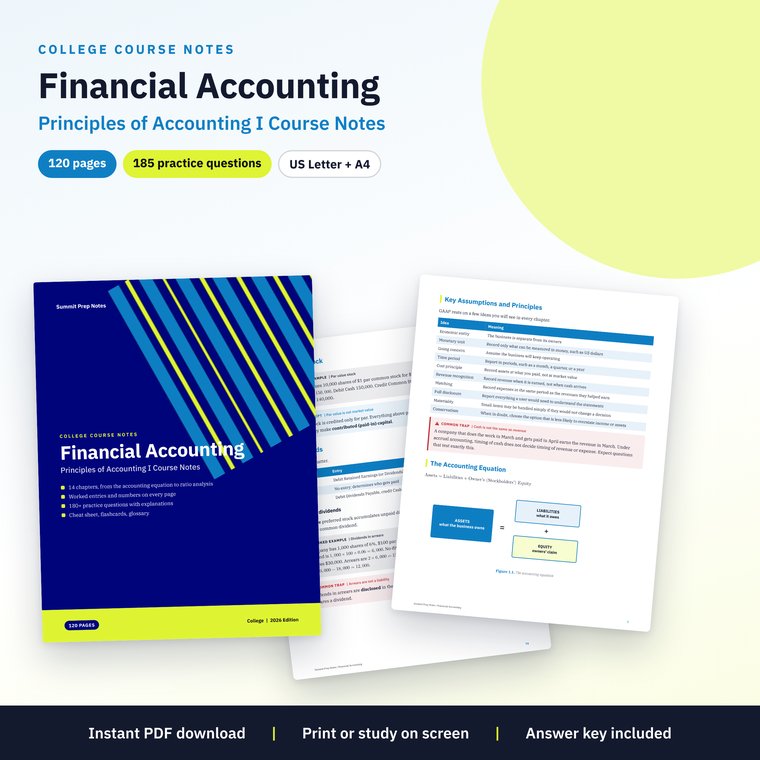
This financial accounting study guide covers a full first-semester course, from the accounting equation and journal entries to bonds, stock, cash flows, and ratio analysis.
- 14 chapters
- Worked entries
- 185 explained practice questions
How do you build a study guide from scratch?
A study guide is a set of exam tasks you can attempt and check. Start with the exam scope, then give each topic a prompt, an answer key, and a place to record what you missed.
- Check the exam scope and format. Write down the date, time limit, question types, and allowed materials. Use the instructor’s review sheet or the exam provider’s outline. For a license test, use the insurance exam preparation guide for planning, and check Alabama’s insurance licensing steps if you’re testing there.
- Rank topics by weight and weakness. Try one representative question per topic before filling in your notes. If two topics carry equal weight, work first on the one you couldn’t start without help. Mark low-weight topics you already know for a quick check later.
- Copy the template once per topic. Use this line in a notebook or document: Topic | Exam task | Key rule | Worked example | Practice prompt | Answer or rubric | Error | Retest date. Put the answer on the reverse side or in a separate document so you can’t see it during practice.
- Match the prompt to the test. For multiple choice, explain why the closest wrong answer is wrong. For math, solve a fresh problem and show your steps. For an essay, draft a claim and pick two pieces of evidence under a time limit.
- Test, log, and retry. Close your notes, answer the prompt, and record the specific error. Replace “bad at fractions” with “multiplied only one side by the denominator.” Try a different version in your next session. If you’re planning for a licensing test, use these insurance exam study tips and resources for more ways to organize practice.
What does a completed study guide entry look like?
A completed study guide entry for an Algebra I quiz starts with a tested skill and ends with a fresh problem that checks whether you’ve corrected your mistake. Suppose Friday’s quiz covers linear equations and your first attempt showed that you dropped a minus sign when distributing.
- Topic and task: Solve a linear equation with parentheses and check the answer by substitution.
- Rule and worked example: Multiply every term inside the parentheses. For
-2(x - 3) = 10, write-2x + 6 = 10, then-2x = 4, sox = -2. - Practice prompt: Solve
-3(x - 4) = 21without notes. - Answer key:
-3x + 12 = 21, sox = -3. Substituting gives-3(-7) = 21. - Error and retest: If you wrote
-3x - 12, underline the two negative factors. On Thursday, try-4(x - 2) = 20. The answer isx = -3. Mark the skill ready only if you can show the expansion and check without help.
How do you fix a study guide that isn’t helping?
A study guide that leaves you blank on practice questions usually needs better prompts, not more notes. Use your last missed question to decide what to change.
- The guide reads like a textbook. Replace a copied paragraph about supply and demand with a scenario: “What happens to equilibrium price if supply falls and demand stays the same?”
- You remember the answer but can’t repeat the method. Change the numbers or the scenario and solve again. For an accounting entry, switch a cash purchase to a purchase on credit and identify which account changes.
- You know the material but run out of time. Practice a small mixed set at exam pace. If your test allows 60 minutes for 30 equally weighted questions, start with six questions in 12 minutes and review where you got stuck.
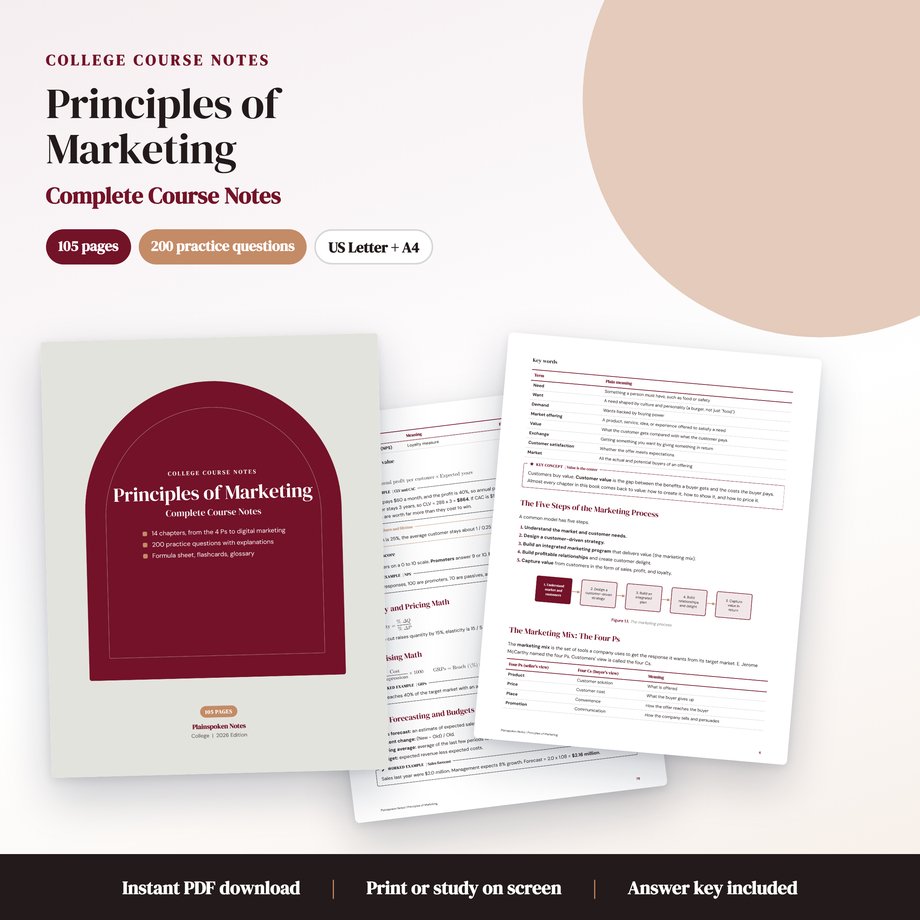
This principles of marketing study guide follows the standard intro course from the four Ps to digital marketing, in plain language.
- AIDA and STP diagrams
- 200 explained practice questions
- 60-question practice exam
When is a ready-made study guide worth using?
A ready-made study guide is worth using when it fills a specific gap, such as giving you fresh questions with explained answers. Check its scope against your course outline or exam blueprint before assigning yourself chapters.
For first-semester accounting, the Trial Balance Financial Accounting Study Guide gives you worked journal entries to cover and attempt on your own.
For introductory marketing, use the Plainmark Principles of Marketing Study Guide to find models such as AIDA, then explain how a real ad applies one.
For Texas STAAR Algebra I EOC prep, use the Isolate It Texas STAAR Algebra I EOC Study Guide to pull fresh problems from your weakest reporting category.
For Praxis 5622, use the Slatewise Praxis 5622 Study Guide to practice writing a constructed response before reading the worked case.
How do teachers turn lesson plans into study guides?
A lesson plan is a teacher’s outline for instruction and practice. To make a student study guide, turn each objective into a task students can check. For example, replace “identify a theme” with “state a theme and support it with two details from the text.”
Choose a resource that matches the lesson: High-Quality Lesson Planning for objectives, A Teaching Guide to Where the Red Fern Grows for literature, the Orton-Gillingham Lesson Planning Companion Guide for decoding, or Middle School ESL Lesson Plans for the Whole Year for academic language.
Planning objectives and literature review
Pair High-Quality Lesson Planning (Quick Reference Guide) with your objectives. Turn one objective into an exit question, then write a parallel question for exam review.

Use Remedia Publications’ A Teaching Guide to Where the Red Fern Grows to frame reading comprehension tasks, such as explaining a character’s decision with a detail from the novel.

Decoding and academic language practice
With the Orton-Gillingham Lesson Planning Companion Guide, select a decodable phrase that uses the pattern students will be asked to read independently.

Use Middle School ESL Lesson Plans for the Whole Year for grades 6–8 academic language practice. For a comparison task, give students two short passages and ask them to state one similarity and one difference.

Common questions
A study guide can fit on one page, work in a group, or support an oral exam. Let the way you’ll be tested determine what you put on the page.
How long should a study guide be?
A one-page study guide can be enough for a short quiz if it gives each tested skill a prompt and points to a separate answer key. For a cumulative final, group pages by unit and keep detailed solutions out of the main guide.
Should I type or handwrite my study guide?
Type a study guide if you’ll need to rearrange topics or add prompts throughout the term. Handwrite it if equations or diagrams are quicker on paper. Pick the format that leaves you more time to answer questions without looking at the key.
Can I use a shared study guide?
A shared study guide works best when everyone checks contributed answers against course materials before studying from it. Assign one topic per person, then exchange prompts without the answers. Resolve disagreements using lecture notes, an assigned reading, or the instructor’s rubric.
What should I put in a study guide for an oral exam?
An oral exam study guide should pair each prompt with a short scoring checklist rather than a script to memorize. Record one spoken answer, then check whether you made a clear claim, gave a specific example, and finished within the allotted time.
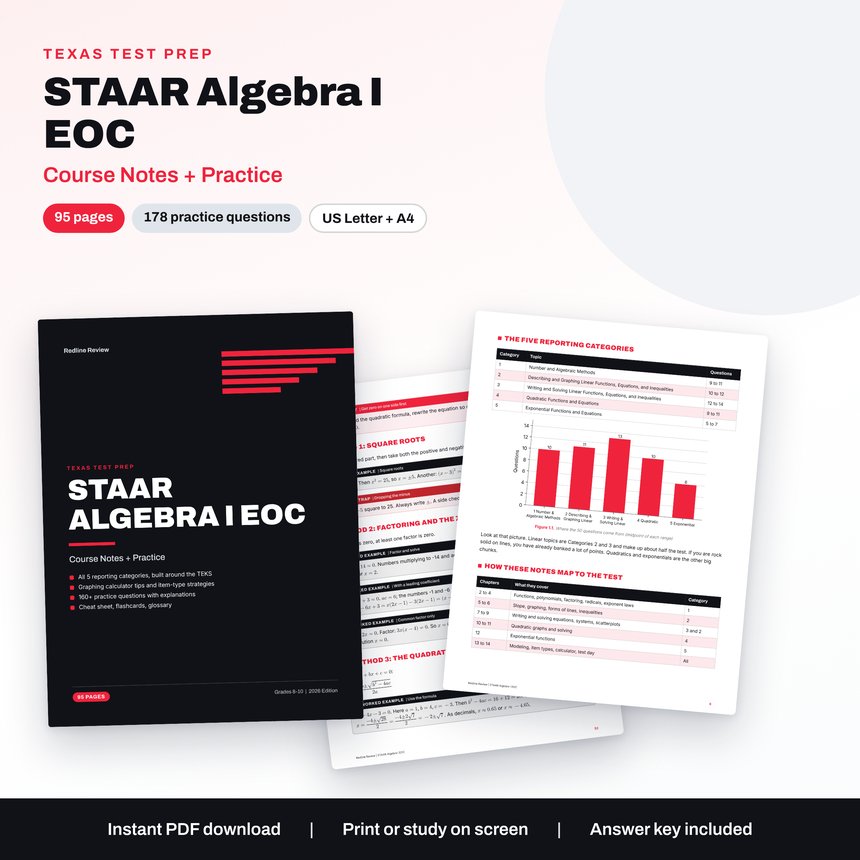
This STAAR Algebra I EOC study guide covers all five reporting categories with clear steps, worked examples, and plenty of practice.
- Five reporting categories
- 14 chapters
- 178 explained practice questions