 Insurance Curator
Banking fees are one of the sneakiest budget busters. A $12 monthly maintenance fee here, a $3 ATM charge there — it adds up fast. For anyone trying to stick to a budget, these small leaks can drain hundreds of dollars from your finances every year. The good news? Many of these fees are completely avoidable once you know how to evaluate them. In this comprehensive guide, you’ll learn exactly how to dissect bank fee schedules, spot hidden charges, and choose accounts that keep your money where it belongs: in your pocket.
Why Banking Fees Matter for Your Budget
Every dollar in fees is a dollar you could put toward savings, debt repayment, or an emergency fund. According to a recent study, the average American pays over $200 per year in bank fees alone. That’s money that could have funded a small vacation or a month’s worth of groceries. When you’re budgeting down to the last cent, ignoring banking fees is like leaving a leaky faucet running — you won’t notice it immediately, but the loss is real.
A solid budget tracks every expense, including recurring bank charges. By evaluating fees upfront and choosing accounts that align with your financial habits, you can stop paying for services that many banks now offer for free. You can also use tools like a Budget Planner – Monthly Budget Book with Expense Tracker Notebook, Undated Bill Organizer & Finance Planner to Take Control of Your Money, Account Book to Manage Your Finances-Pink — $8.99, rating 4.6 to log and monitor these charges. When you see them in writing, they become impossible to ignore.
The Most Common Banking Fees You Need to Know
Before you can avoid banking fees, you need to recognize them. Below is a breakdown of the fees banks charge most often, along with typical amounts and warning signs.
Monthly Maintenance Fees
This is a flat fee charged simply for having an account open. It ranges from $5 to $25 per month. Banks often waive it if you meet certain conditions like a minimum balance, direct deposit, or a certain number of transactions.
Example: Chase Total Checking charges $12 per month unless you have at least $1,500 in direct deposits or a $5,000 daily balance. Over a year, that’s $144 — easily avoidable.
ATM Fees
Using an out-of-network ATM can cost you two fees: one from the ATM owner ($2–$5) and another from your own bank ($2–$5). So a simple $20 withdrawal could cost $10 in fees.
Overdraft and Non-Sufficient Funds (NSF) Fees
If you spend more than your balance, the bank covers the transaction and charges $30–$35 per incident. Some banks also charge a sustained overdraft fee if you don’t repay within a few days.
Foreign Transaction Fees
When you use your debit card abroad, banks often tack on 1–3% of each transaction. This fee applies even when paying in foreign currency online.
Paper Statement Fees
Believe it or not, some banks still charge $1–$3 per month if you want a mailed paper statement. Going paperless eliminates this charge instantly.
Account Closing Fees
A handful of banks charge $25–$50 if you close an account within 90–180 days of opening. Always read the fine print before switching.
Inactivity Fees
If you don’t use your account for several months, some banks charge a dormant account fee. This is rare but worth checking, especially for seldom-used savings accounts.
How to Evaluate Banking Fees Like a Pro
Evaluating fees isn’t just about reading a list — it’s about understanding how each fee applies to your personal banking habits. Follow this step-by-step process to score any account.
Step 1: Request the Full Fee Schedule
Every bank is required to provide a fee schedule. Ask for it before you open an account. Look for fees that have “may apply” language — those are often discretionary and can be negotiated.
Step 2: Calculate Your Monthly Usage
Grab your transaction history for the last three months. Count:
- Number of ATM withdrawals (and which ATMs)
- Average balance
- Direct deposit amount
- Number of debit transactions
- Any overdraft incidents
Now compare each of these to the fee waiver requirements. For example, if you typically maintain a $500 balance but the bank requires $1,500 to waive the monthly fee, you’ll be charged.
Step 3: Use a Banking Fee Calculator
Many websites offer free calculators where you input your usage and it projects annual fees. This makes hidden fees visible. You can also manually create a spreadsheet — or use a Budget Binder like this SKYDUE Budget Binder with Zipper Envelopes ($8.98, rating 4.7) to track ongoing charges.
Step 4: Compare Accounts Side-by-Side
Create a comparison table with the accounts you’re considering. Include every fee type and the waiver conditions. Here’s an example:
| Fee Type | Bank A (Free Checking) | Bank B (Standard Checking) | Bank C (Premium) |
|---|---|---|---|
| Monthly maintenance | $0 | $12 (waived with $1,500 balance) | $25 (waived with $10,000 balance) |
| Out-of-network ATM | $2 + $2 ATM owner | $2.50 + $3 ATM owner | $0 (unlimited reimbursements) |
| Overdraft fee | $34 | $35 | $0 (free overdraft protection) |
| Foreign transaction | 1% | 3% | 0% |
| Minimum opening deposit | $0 | $25 | $100 |
This visual instantly shows you which account costs less based on your usage.
Step 5: Read the Fine Print on “Free” Accounts
Many banks advertise “free checking” but bury exceptions. Free checking often means no monthly maintenance fee, but you may still be charged for paper statements, stop payments, or excessive withdrawals. Ask specifically: “Which fees are absolutely zero, and which conditions could trigger a charge?”
Expert Strategies to Avoid Paying for Basic Services
Now that you know how to evaluate, here are actionable strategies to keep your banking truly free.
Choose Online Banks and Credit Unions
Online banks have lower overhead and often offer zero monthly fees, unlimited ATM fee reimbursements, and free checks. Credit unions are member-owned and typically charge fewer and lower fees than big banks.
Example: Ally Bank and Capital One 360 charge no monthly maintenance fees, no overdraft fees, and offer extensive ATM networks.
Meet Waiver Requirements Strategically
If you prefer a traditional bank, set up direct deposit of at least $500 per month — most will waive the monthly fee for that alone. Or keep a minimum daily balance by automating transfers from a linked savings account.
Opt Out of Overdraft Protection
By law, you can decline overdraft coverage on debit card transactions. If you do, the transaction will be declined instead of triggering a $35 fee. This is one of the easiest ways to eliminate overdraft fees.
Use Cash Envelopes for Spending
A budgeting method like the envelope system physically partitions cash for categories. This prevents overdrafts and keeps you from using ATMs frequently. The NICOOTH Budget Binder Cash Envelopes A6 Money Saving Binder with Zipper envelopes (Purple) — $6.28, rating 4.6 is perfect for this approach.
Sign Up for Alerts
Set up text or email alerts for low balances, large withdrawals, and upcoming fees. Catching a potential overdraft before it happens is the best prevention.
Negotiate Fees Already Charged
Most banks will reverse a fee if you ask politely — especially if it’s your first offense. Call customer service and say, “I see a $35 overdraft fee. Can you waive it as a courtesy?” Success rates are high if you have a good history.
Consolidate Accounts
Having multiple accounts at different banks increases your exposure to fees. Consolidate checking, savings, and perhaps a CD at one institution to meet balance requirements and qualify for premium fee waivers.
How to Track Banking Fees in Your Budget
Even with the best account, occasional fees may slip through. That’s why tracking is essential. Include a “Banking Fees” line in your budget spreadsheet or book.
Use a Budget Planner Specifically for Expense Tracking
The Budget Planner – Monthly Budget Book with Expense Tracker Notebook, Undated Bill Organizer & Finance Planner to Take Control of Your Money, Account Book to Manage Your Finances-Black — $8.99, rating 4.6 has dedicated sections for miscellaneous expenses. Write down every fee you incur, then at the end of the month, analyze which ones could have been avoided.
Digital Alternatives
Apps like Mint or YNAB automatically categorize bank fees. But a physical planner can be more effective for visual learners who want to see the pattern.
Set a Monthly Threshold
Decide upfront: “I will not pay more than $5 in bank fees per month.” If you exceed that, adjust your account usage. For example, if ATM fees are the problem, start using only in-network machines or get cash back at stores.
Real Examples: How Much You Can Save by Avoiding Fees
Let’s look at two scenarios — one who pays fees passively, one who evaluates and eliminates them.
Case 1: Fee-Aware Ben
Ben uses a checking account with a $10 monthly maintenance fee (waived with $1,500 balance, but he keeps $800). He makes two out-of-network ATM withdrawals per month costing $6 total. He had one overdraft fee of $34 last year. Total annual fees: $120 (maintenance) + $72 (ATM) + $34 = $226.
Case 2: Fee-Free Sarah
Sarah uses an online checking account with no fees and ATM reimbursement. She keeps her budget organized using a Budgeting 101 book ($9.69, rating 4.6) that teaches her to avoid overdrafts. Total annual fees: $0.
Sarah saves $226 per year — enough for a nice dinner out or a contribution to her emergency fund. The simple act of evaluating fees upfront made the difference.
Internal Links: Deepen Your Knowledge
To build a complete understanding of banking products and how they affect your budget, explore these related guides:
- Beginner’s Guide to Banking Products: Checking, Savings, CDs, and More
- How to Choose the Right Checking Account for Your Everyday Money
- High-yield Savings Accounts: What to Look for and How to Compare Offers
- Certificates of Deposit vs. Savings Accounts: Which Banking Product Fits Your Goal?
- Money Market Accounts Explained: Who Should Use Them and Why
- Overdraft Protection, Lines of Credit, and Other Hidden Banking Products
- Mobile-first Banking Products: Features That Actually Make Life Easier
- Using Separate Banking Products to Organize Bills, Goals, and Everyday Spending
- Safe Places to Keep Large Sums of Cash: FDIC Insurance and Banking Product Limits
Reading these will help you select the right mix of accounts for your budget and avoid unnecessary fees.
Recommended Budgeting Tools to Support Your Fee-Free Journey
Investing a small amount in physical budgeting tools can pay for itself many times over by helping you stay organized and fee-aware.
1. Budget Planner – Monthly Budget Book (Pink)
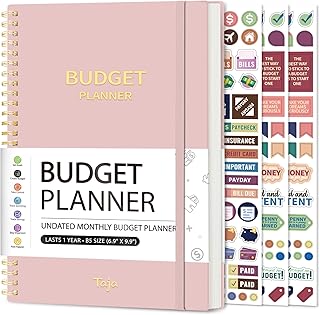
Price: $8.99 | Rating: 4.6 | ASIN: B0C33RXLR6
This undated planner includes sections for tracking expenses, bills, and financial goals. Use it to note banking fees and identify patterns.
2. NICOOTH Budget Binder with Cash Envelopes (Purple)

Price: $6.28 | Rating: 4.6 | ASIN: B09GK8BGRT
A6 size with zipper envelopes for cash-based budgeting — perfect for avoiding out-of-network ATM fees.
3. SKYDUE Budget Binder with Zipper Envelopes

Price: $8.98 | Rating: 4.7 | ASIN: B097ZQ7GH4
Comes with expense budget sheets and cash envelopes. The high rating reflects its durability and usefulness for tracking every dollar.
4. Budget Planner – Monthly Budget Book (Black)

Price: $8.99 | Rating: 4.6 | ASIN: B0C33STDJ2
Same great functionality as the pink version but in a sleek black cover. Perfect for professionals who want to maintain a polished look while managing their banking fees.
5. Budgeting 101 Book (Adams 101 Series)

Price: $9.69 | Rating: 4.6 | ASIN: 150720907X
This book covers the essentials of getting out of debt, tracking expenses, and setting goals. It includes a chapter on avoiding banking fees that aligns perfectly with this article.
FAQ: Common Questions About Banking Fees and Budgeting
1. Are all banking fees negotiable?
Not all, but many are. Monthly maintenance fees, overdraft fees, and late payment penalties can often be waived upon request — especially if you’re a long-term customer or if it’s your first offense. Fees like ATM surcharges from third-party machines are harder to negotiate, but your own bank may refund them if you ask.
2. What is the easiest way to avoid monthly maintenance fees?
Open an account with a bank that has no monthly fees — many online banks and credit unions offer this. If you prefer a traditional bank, set up direct deposit of at least $500 per month or maintain the required minimum balance.
3. How can I track banking fees in my budget?
Use a dedicated line item in your budget planner or app. Every time you incur a fee, log it immediately. At the end of the month, review which fees were unavoidable and which could have been prevented. Tools like the Budget Planner – Monthly Budget Book (Pink) work great for this purpose.
4. Do credit unions charge fewer fees than banks?
Yes, on average. Credit unions are nonprofit cooperatives, so they tend to charge lower fees and offer better rates. Many credit unions have no monthly maintenance fees and lower overdraft fees. However, always check the specific fee schedule — some credit unions still have niche charges.
5. Is it worth paying a fee for premium banking services?
Only if you actually use the premium features. For example, a $25 monthly fee for unlimited ATM reimbursements and free wire transfers makes sense if you travel frequently or move large sums of money. For most people, basic free accounts suffice.
6. What should I do if I notice an unexpected fee?
Contact customer service immediately. Say, “I noticed a charge on my account for $XX, and I don’t understand what it’s for.” Often the fee is a mistake or can be reversed as a courtesy. If it’s legitimate, ask for the waiver conditions and adjust your behavior.
Final Thoughts: Your Money, Your Control
Banking fees are not a necessary evil — they are an optional expense. By evaluating fee schedules, choosing the right accounts, and using budgeting tools to stay on track, you can keep your hard-earned money working for you instead of your bank. Start today by pulling out your fee schedule or requesting one from your bank. Compare it against your habits. The savings may surprise you.
Remember, every dollar saved on fees is a dollar you can redirect toward your financial goals. Whether you use a physical budget binder or a digital app, make fee tracking a non-negotiable part of your budgeting routine. Your future self will thank you.